Community history
Batesville's Furniture Makers
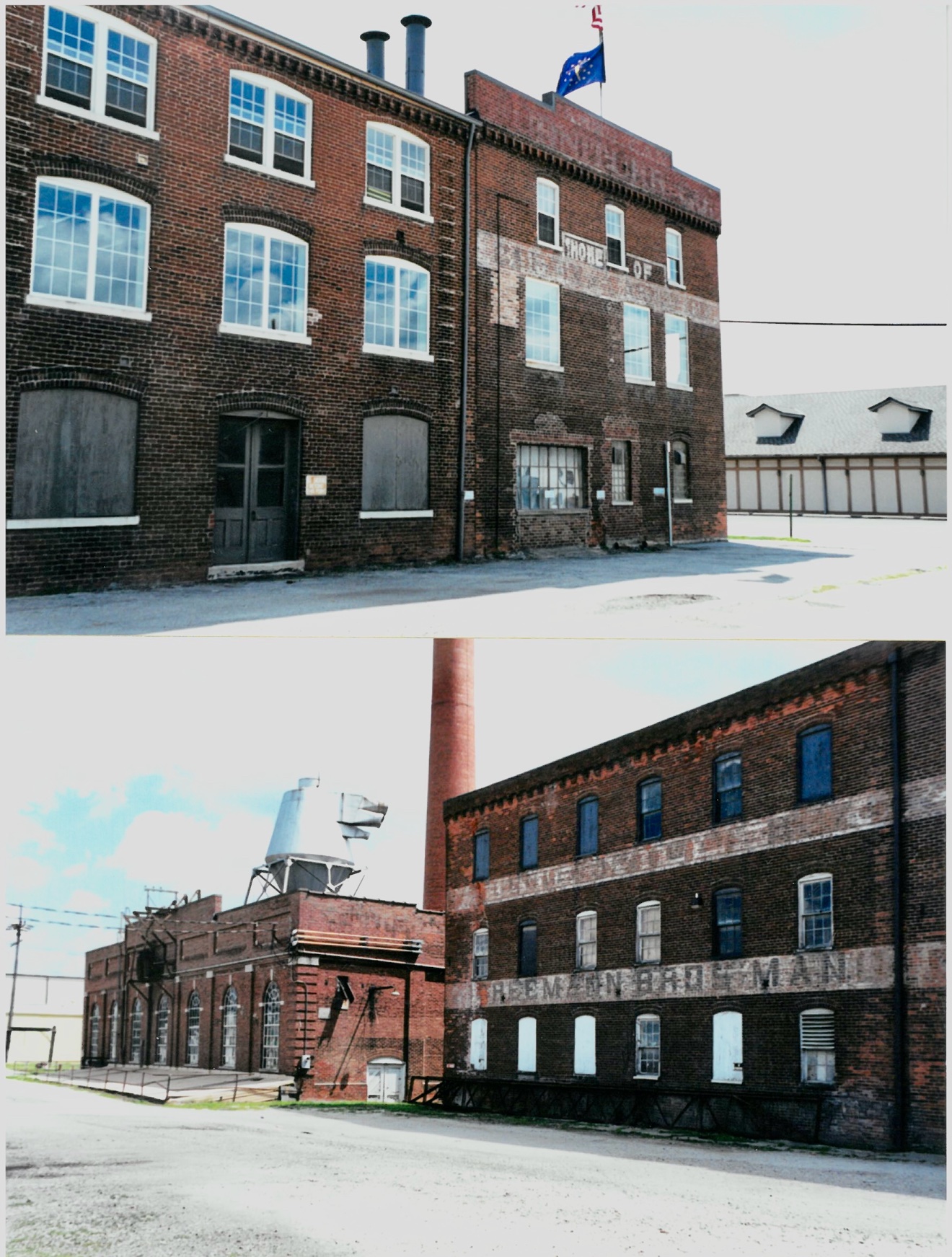
Union Furniture on West George Street, the Casket Company on South Street, and the factories that made Batesville a furniture town.
Photos
Photos of this place.

Source documents
The documents behind this page.
The story so far
What happened here.
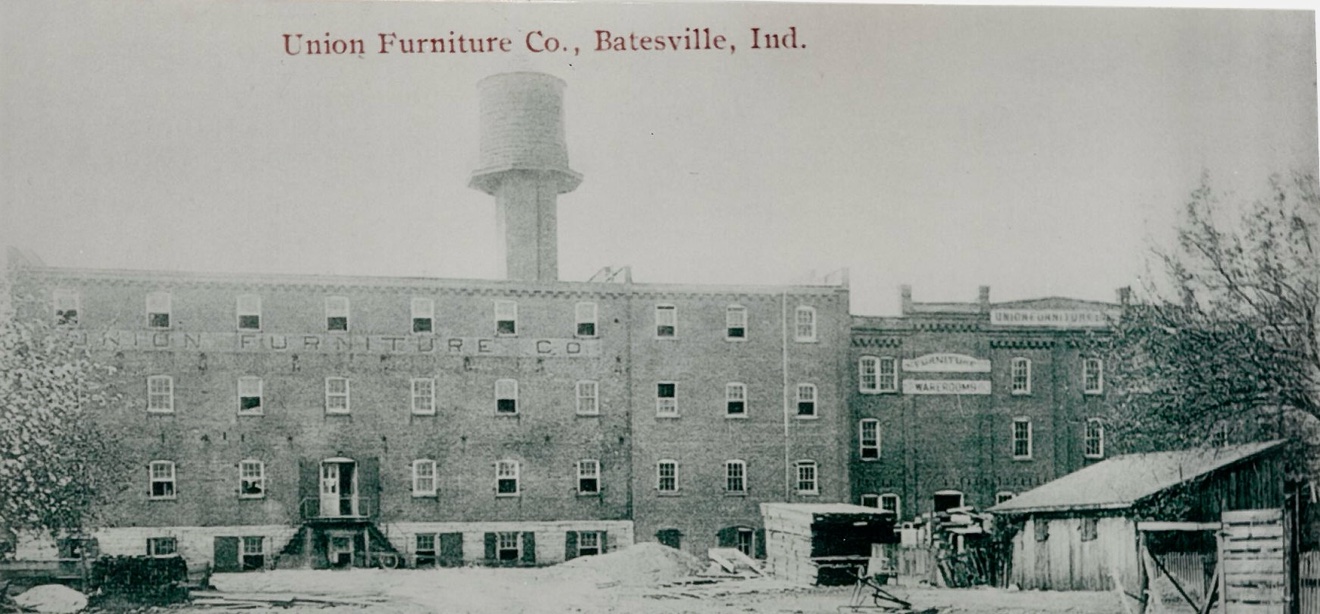
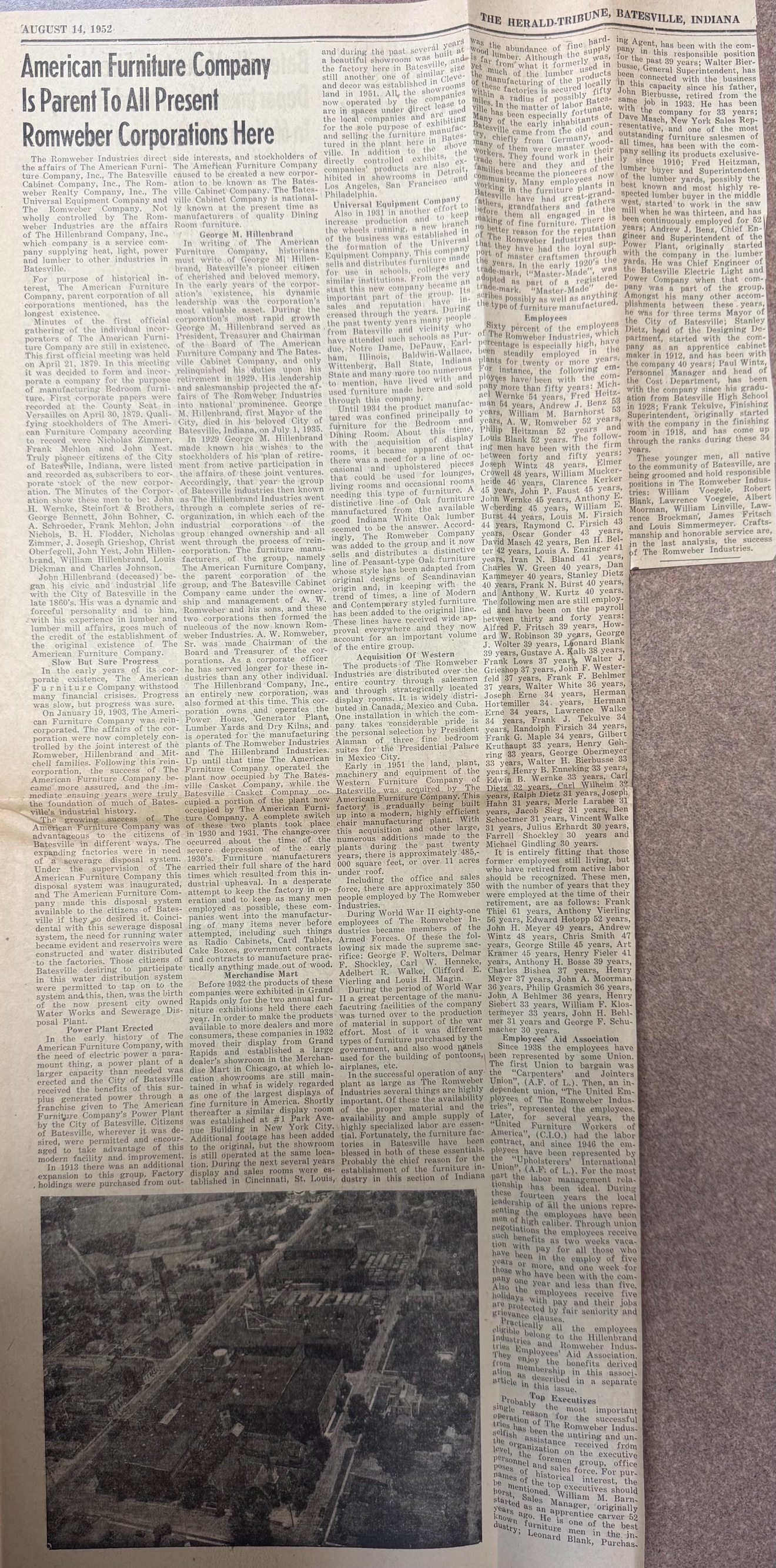
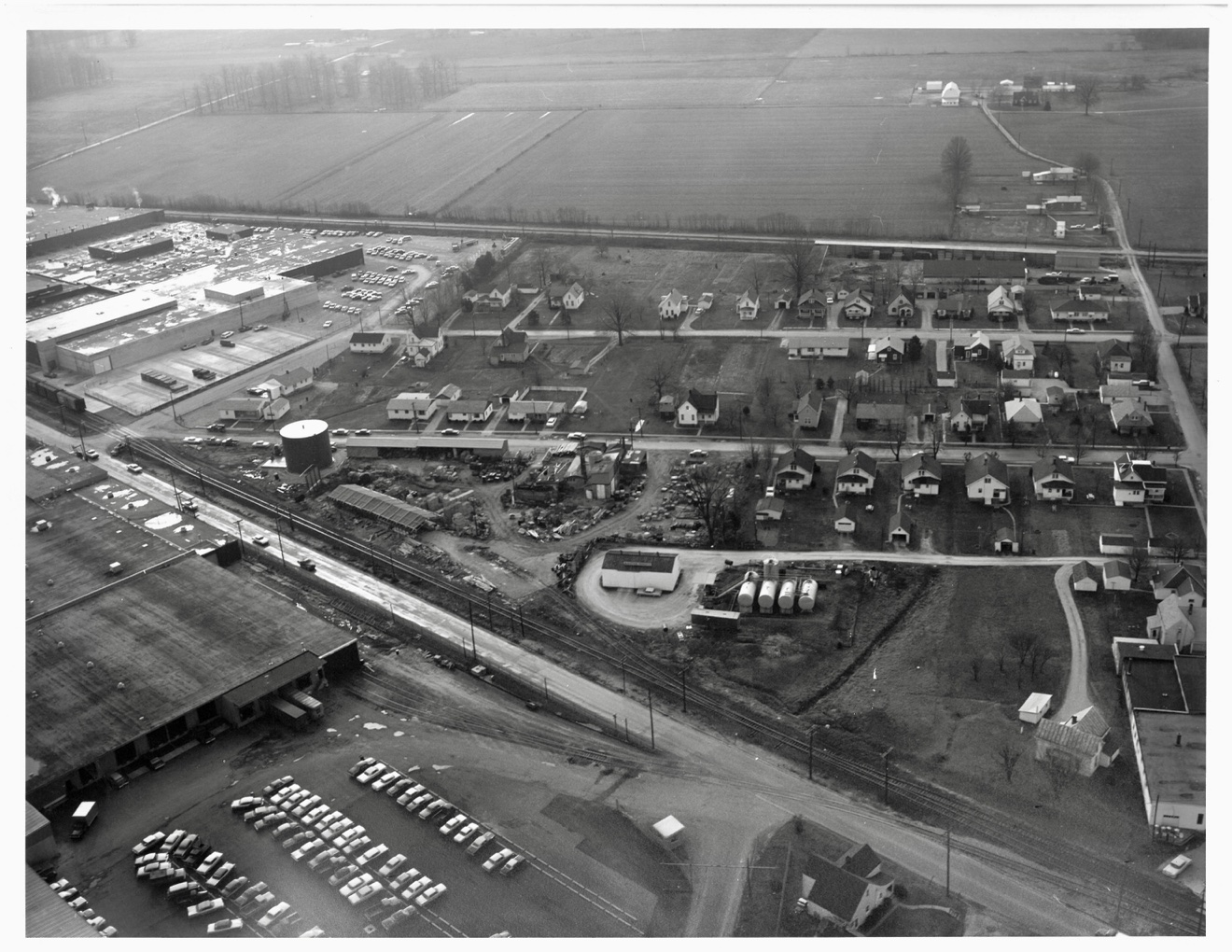
Batesville built furniture — and for a long stretch, furniture built Batesville. The Union Furniture Company worked West George Street, the Batesville Casket Company worked South Street, and behind them both stood the American Furniture Company, founded in 1879, the parent of all the Romweber corporations here.
A local newspaper proclaimed that Batesville produced more wood products per capita than any other town in the United States.
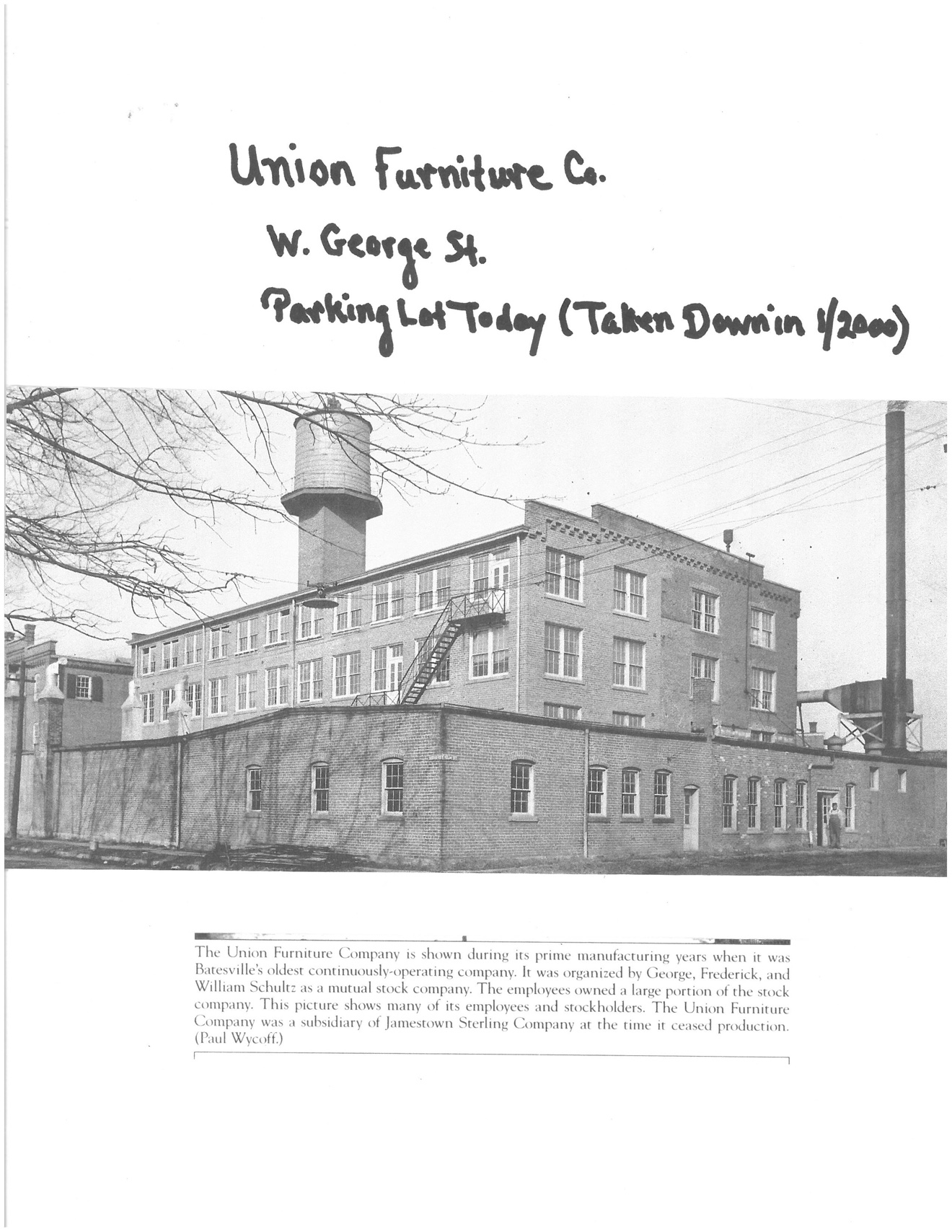
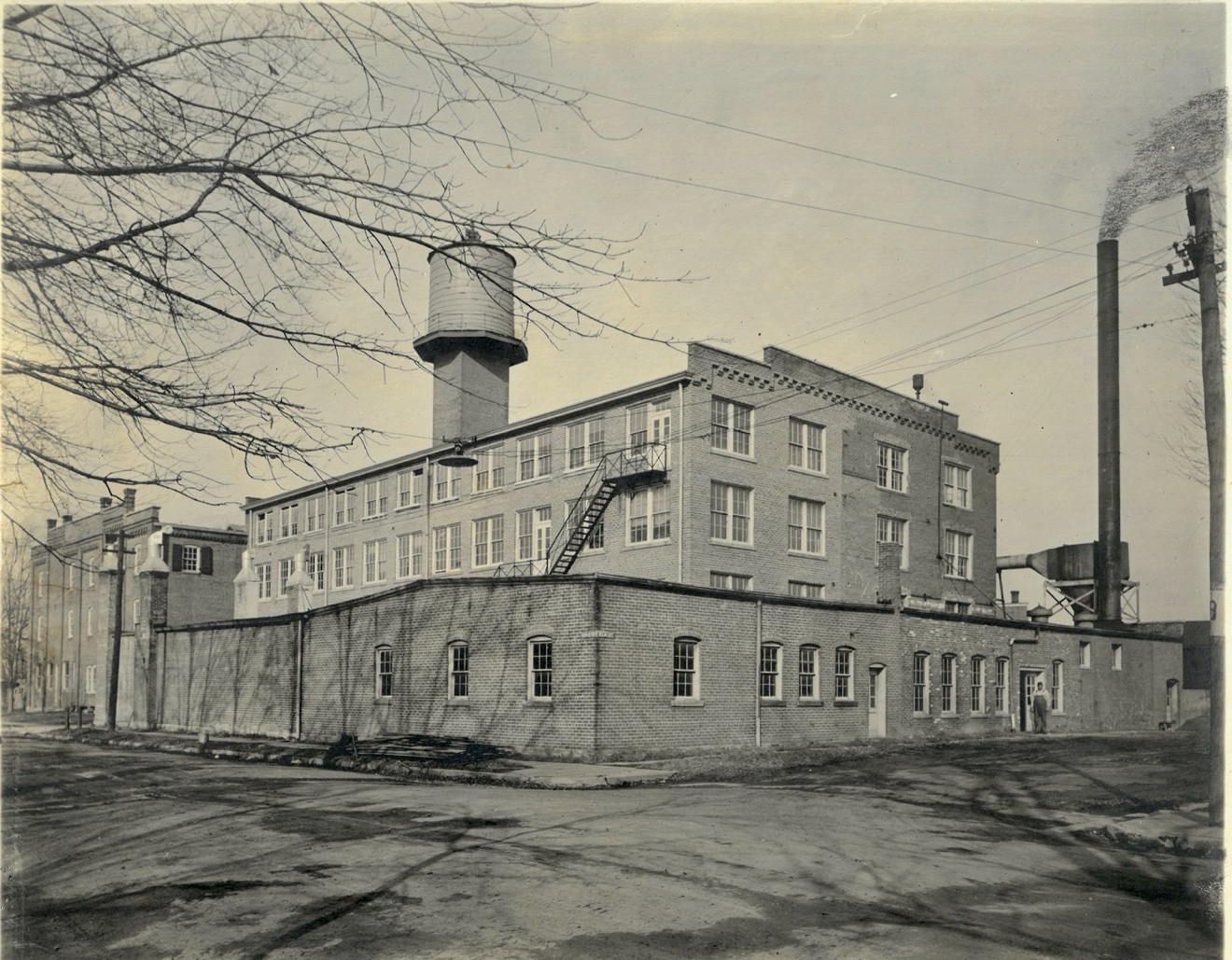
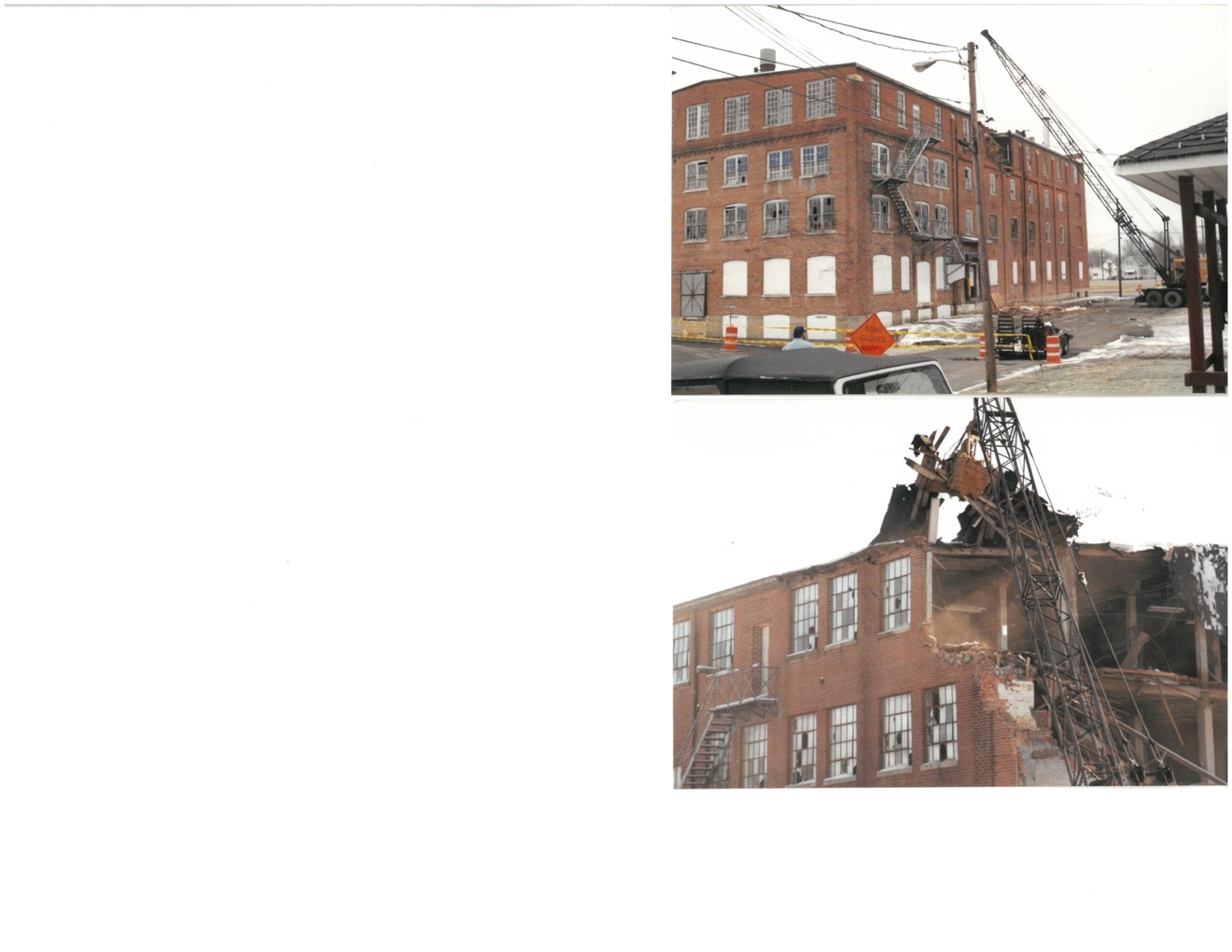
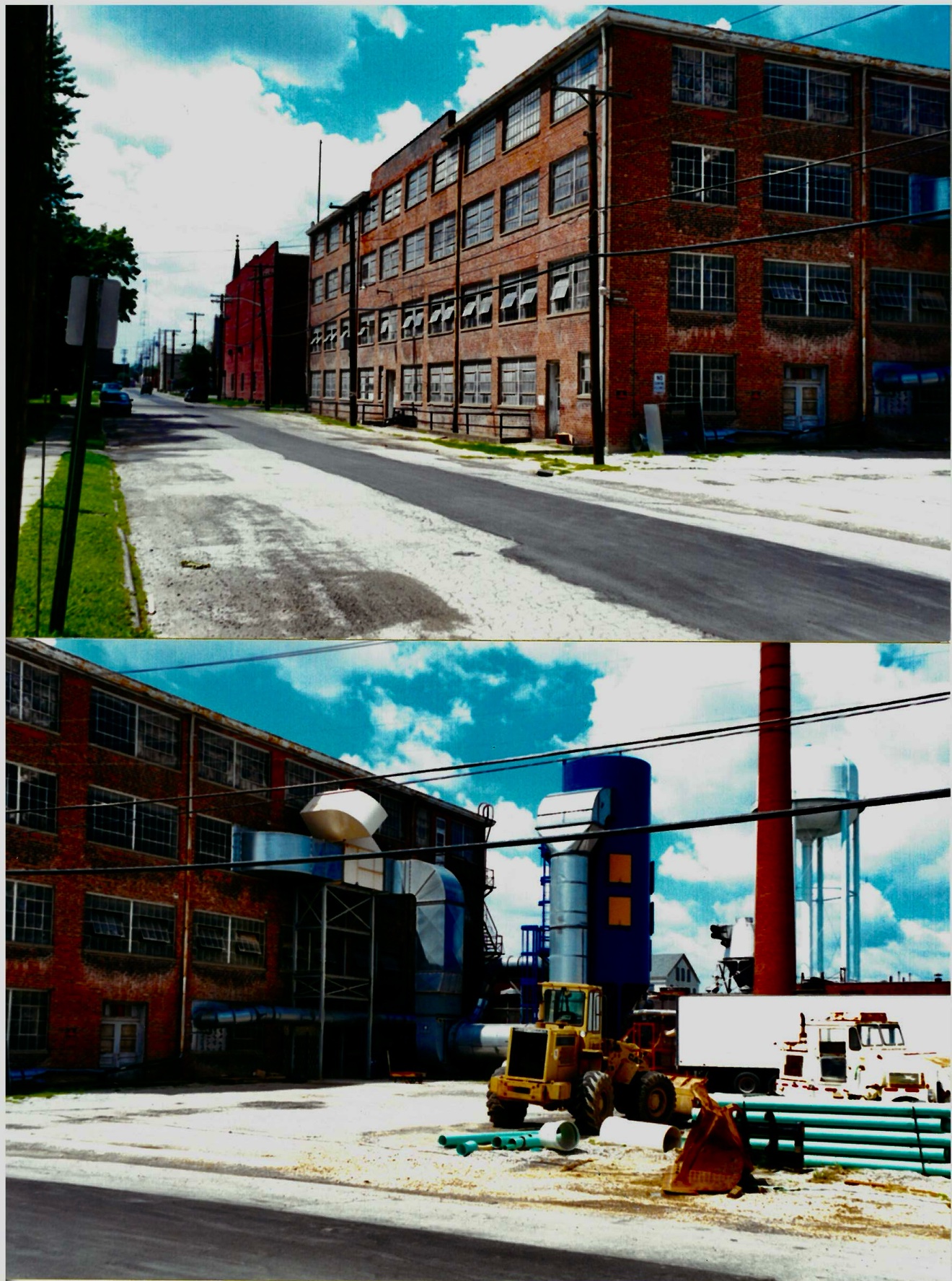
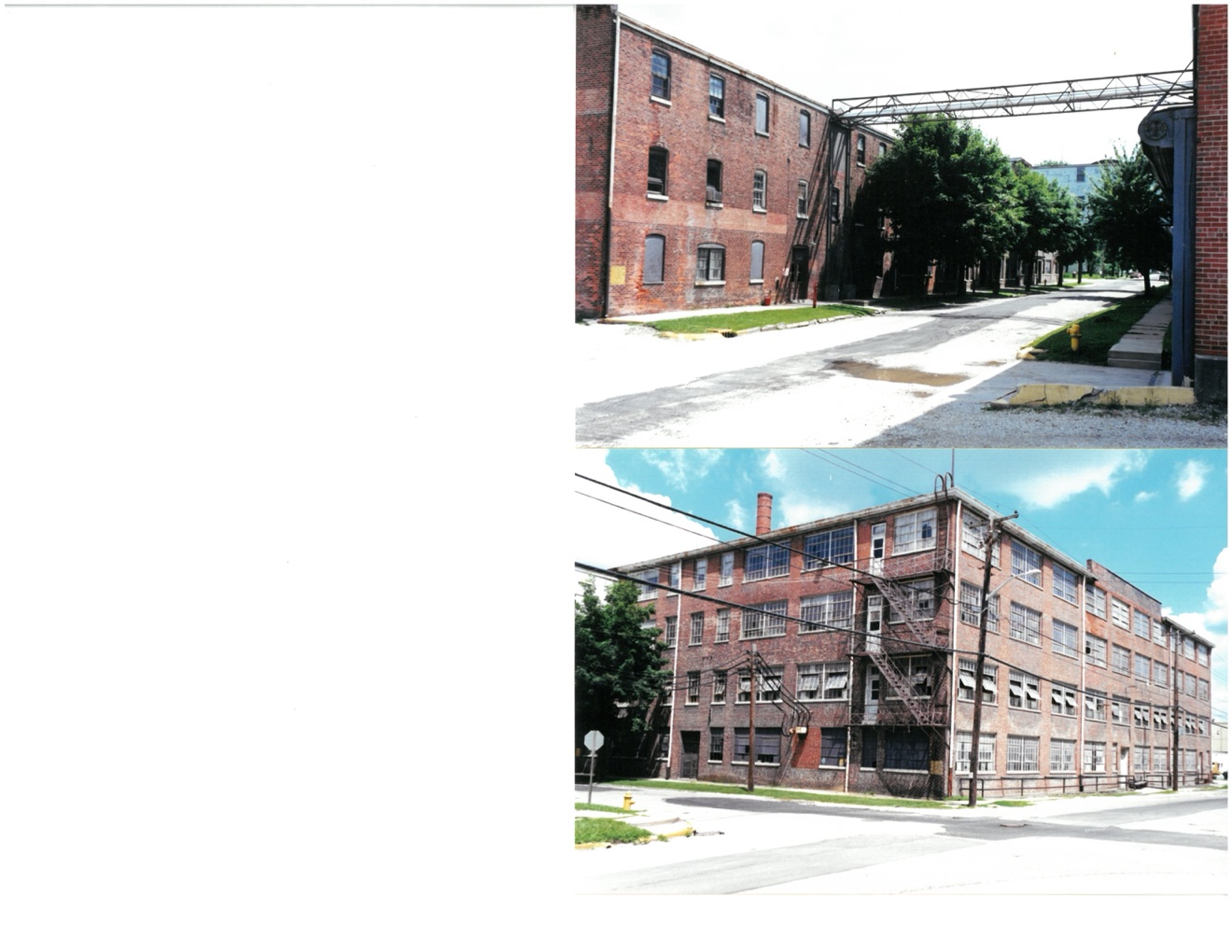
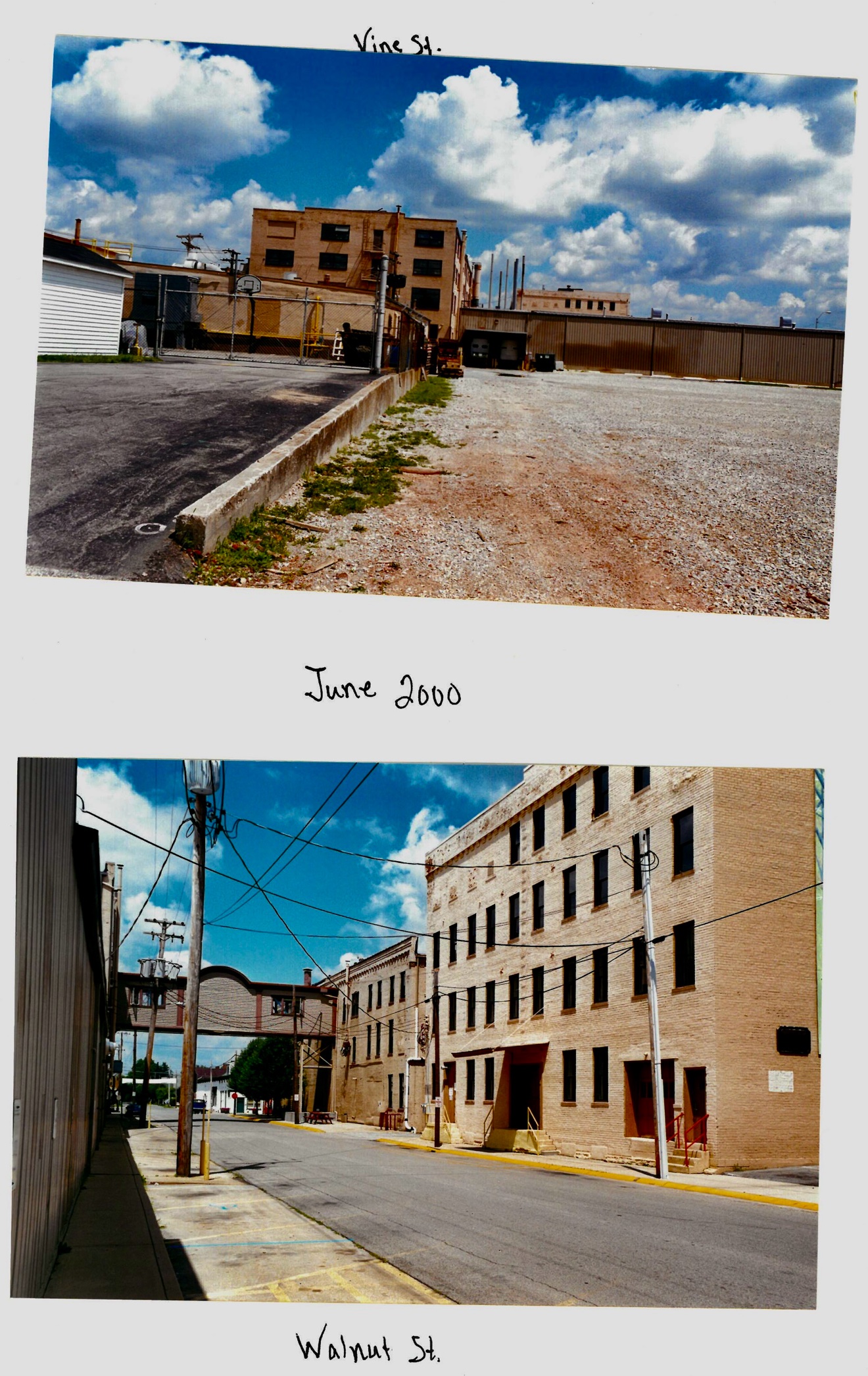
Union Furniture was organized by George, Frederick, and William Schult as a mutual stock company, and the employees themselves owned a large portion of the stock. It was a subsidiary of the Jamestown Sterling Company by the time it ceased production. The building came down in January 2000, and the demolition wasn’t finished until March. The site is a parking lot today.
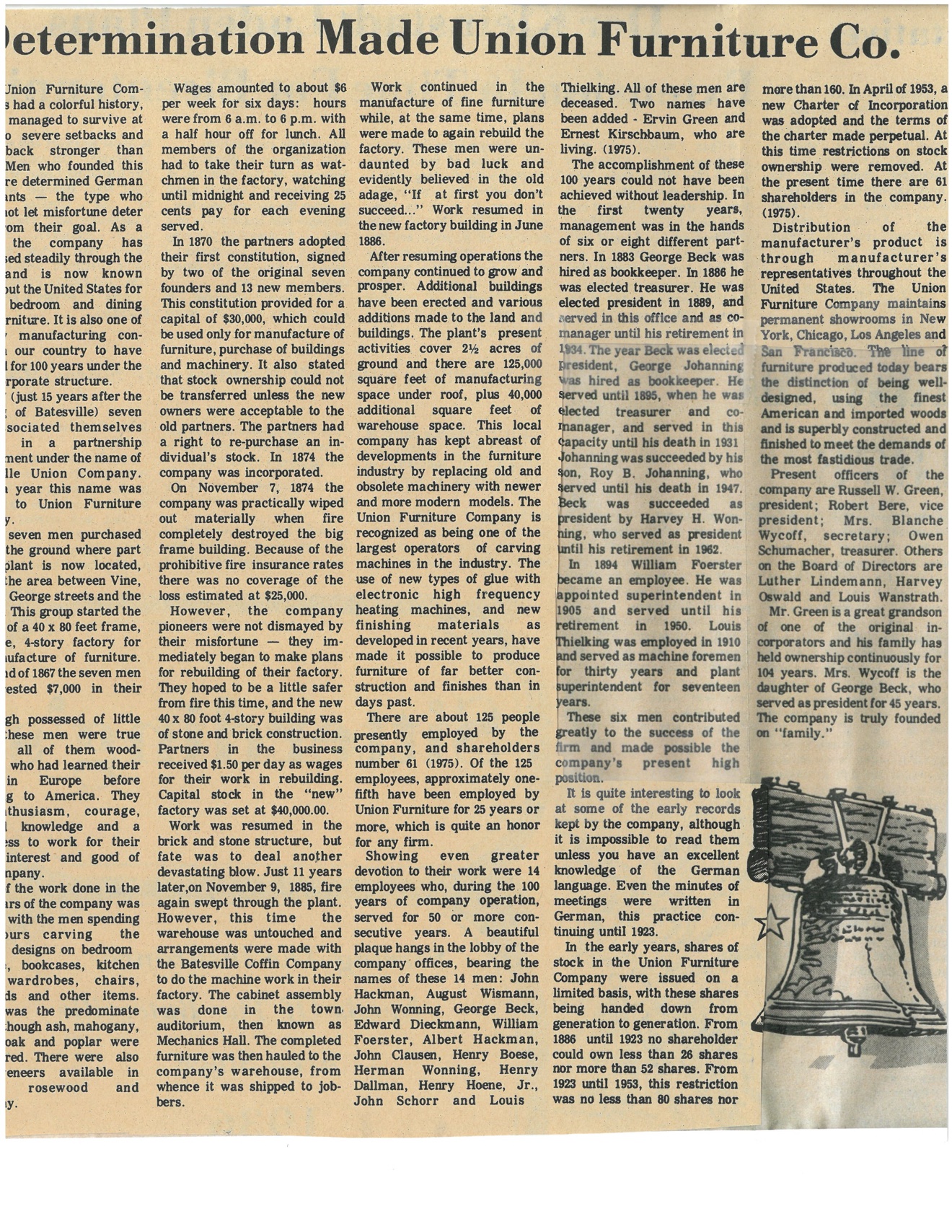
Union’s first hundred years were a story of fires and rebuilding. Seven men put up a frame factory in 1867; fire destroyed it on November 7, 1874, a $25,000 loss with no insurance. They rebuilt in stone and brick, and fire swept the plant again on November 9, 1885. Work resumed in the new building in June 1886, and the company kept going — wages about $6 a week for six days, the men taking turns watching the factory at night for 25 cents an evening.
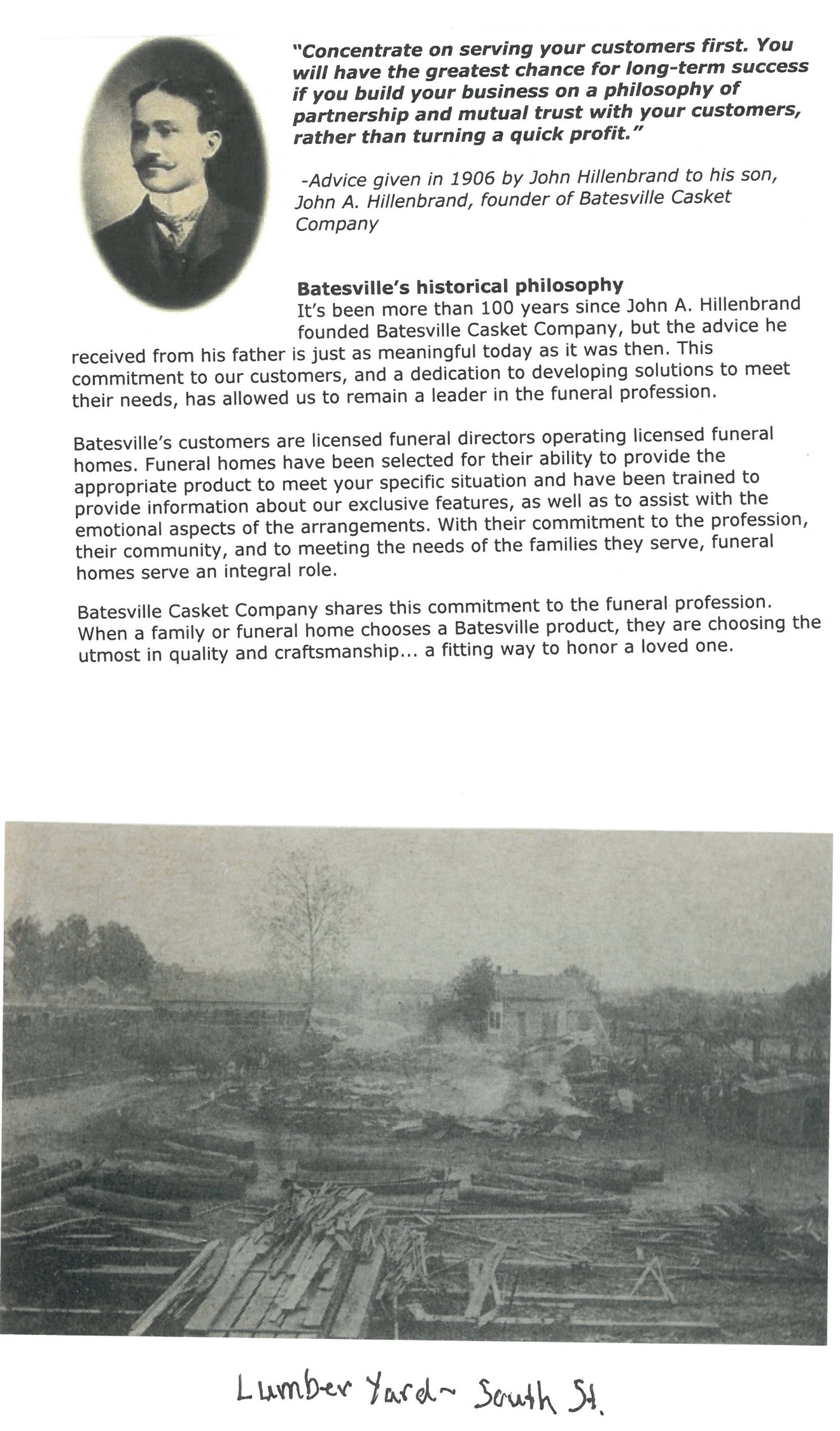
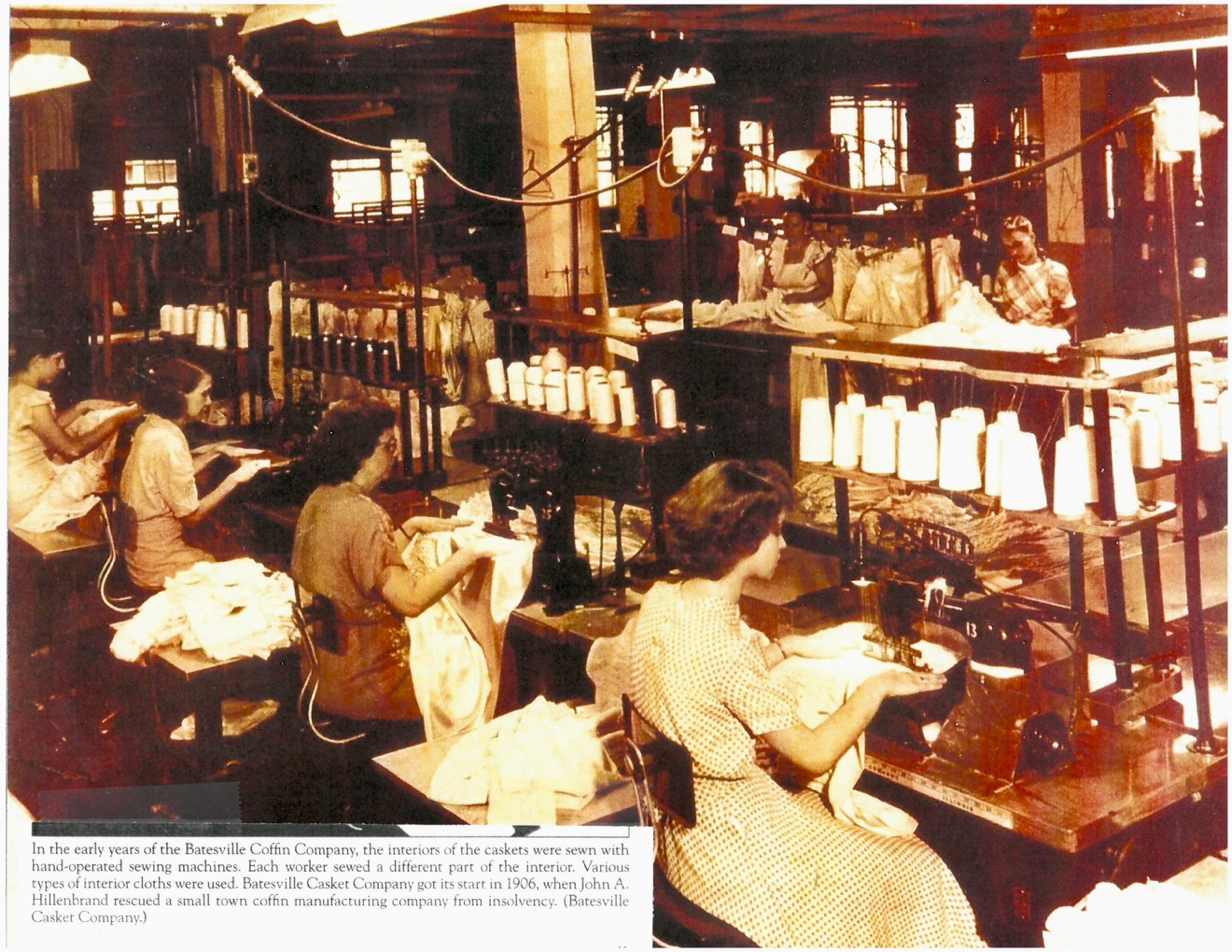
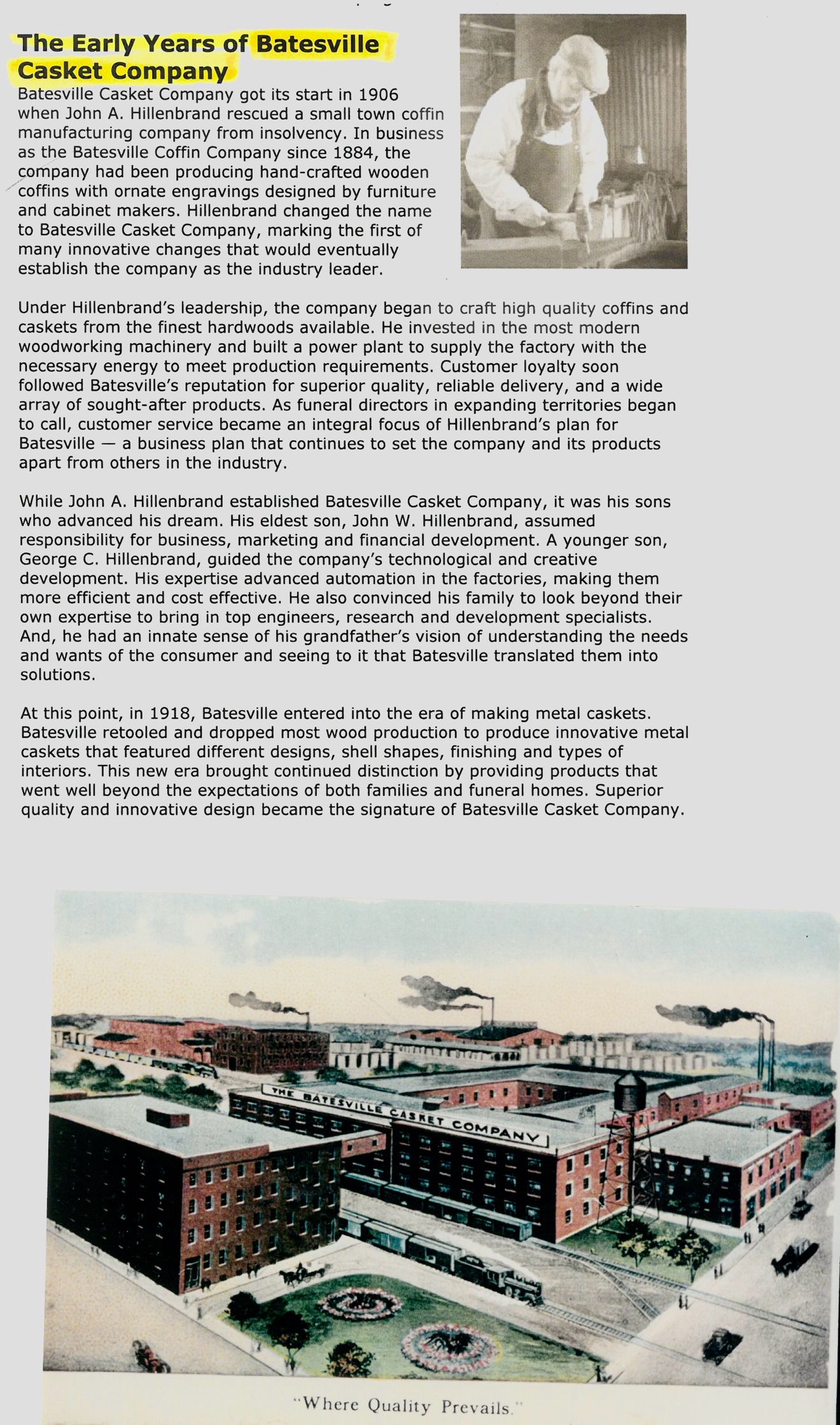
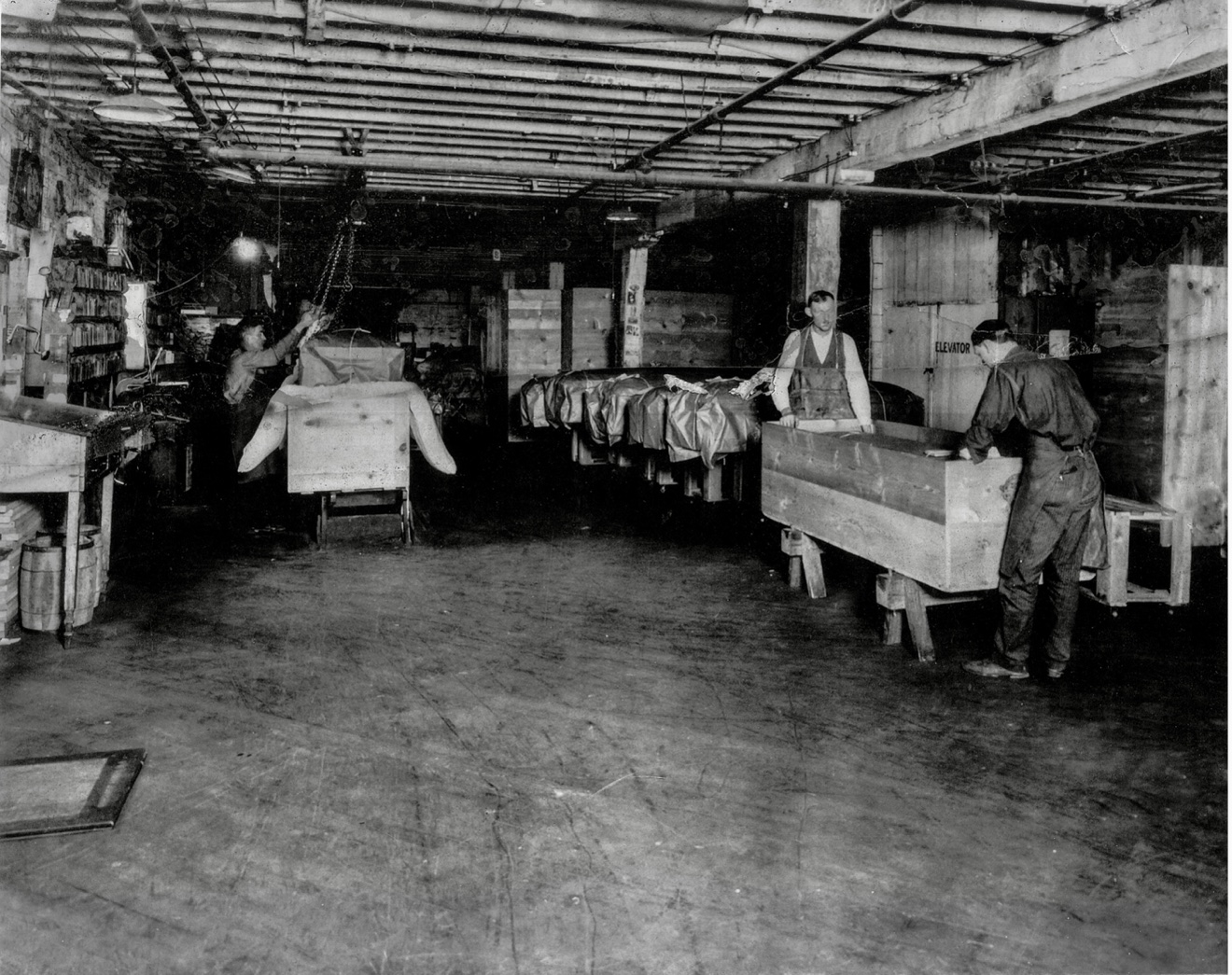
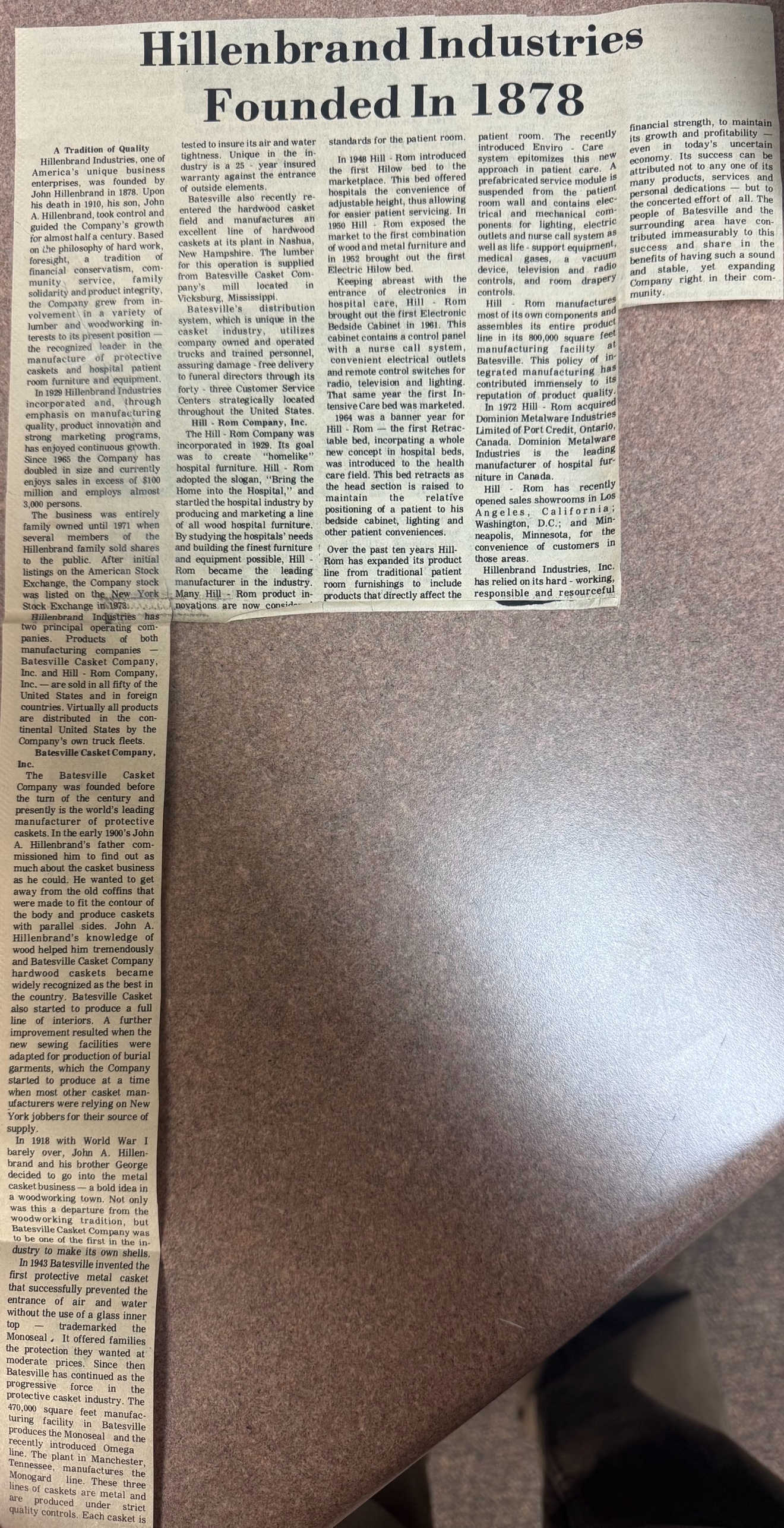
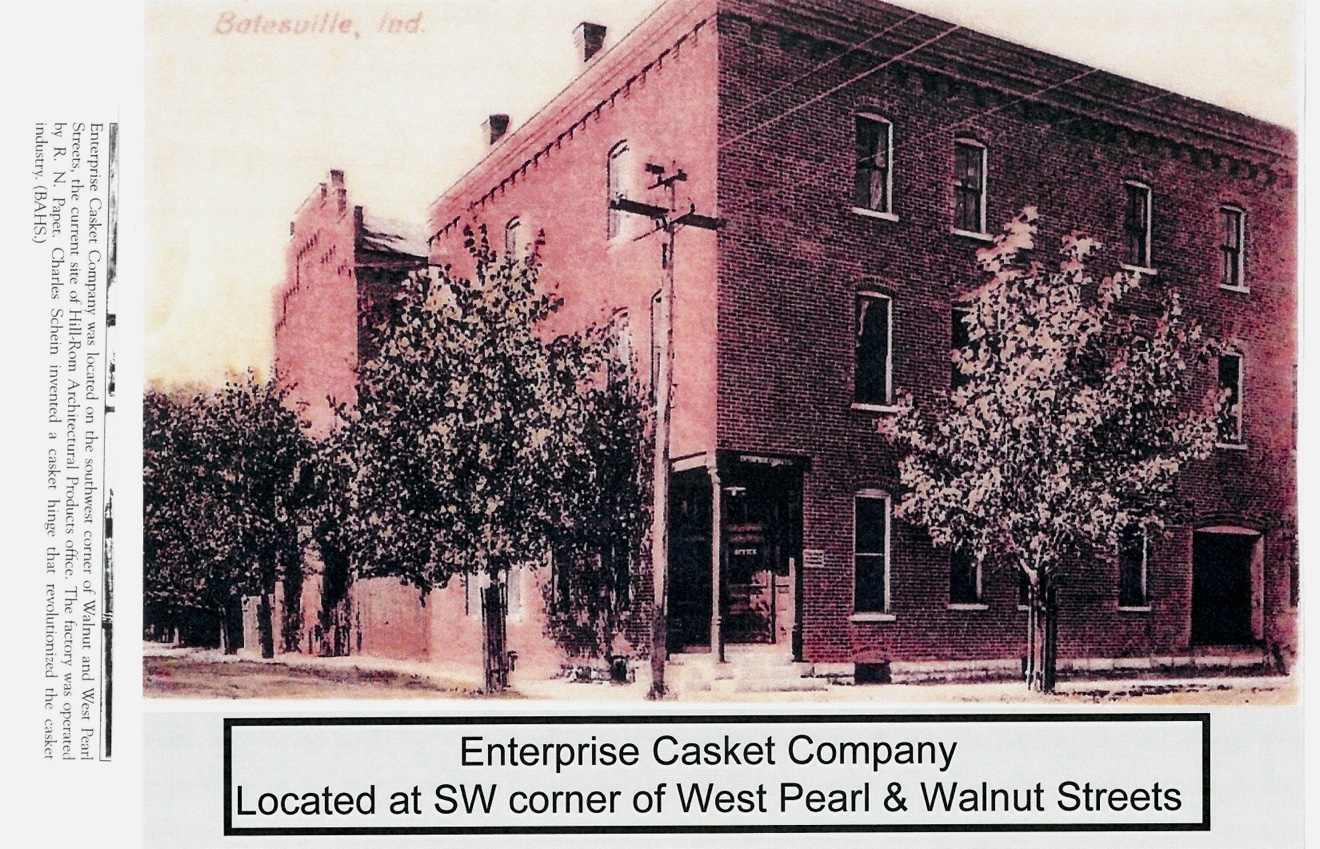
The Casket Company started in 1906, when John A. Hillenbrand rescued a small town coffin maker from insolvency — a business that had been making hand-crafted wooden coffins since 1884. By 1918 the factory had retooled for metal caskets. The advice his father gave him that first year still hangs over the whole story: concentrate on serving your customers first, build on partnership and mutual trust, and the success follows. And the Enterprise Casket Company worked the southwest corner of Walnut and West Pearl, where R. N. Paper ran the factory and Charles Schein invented a casket hinge that revolutionized the industry.
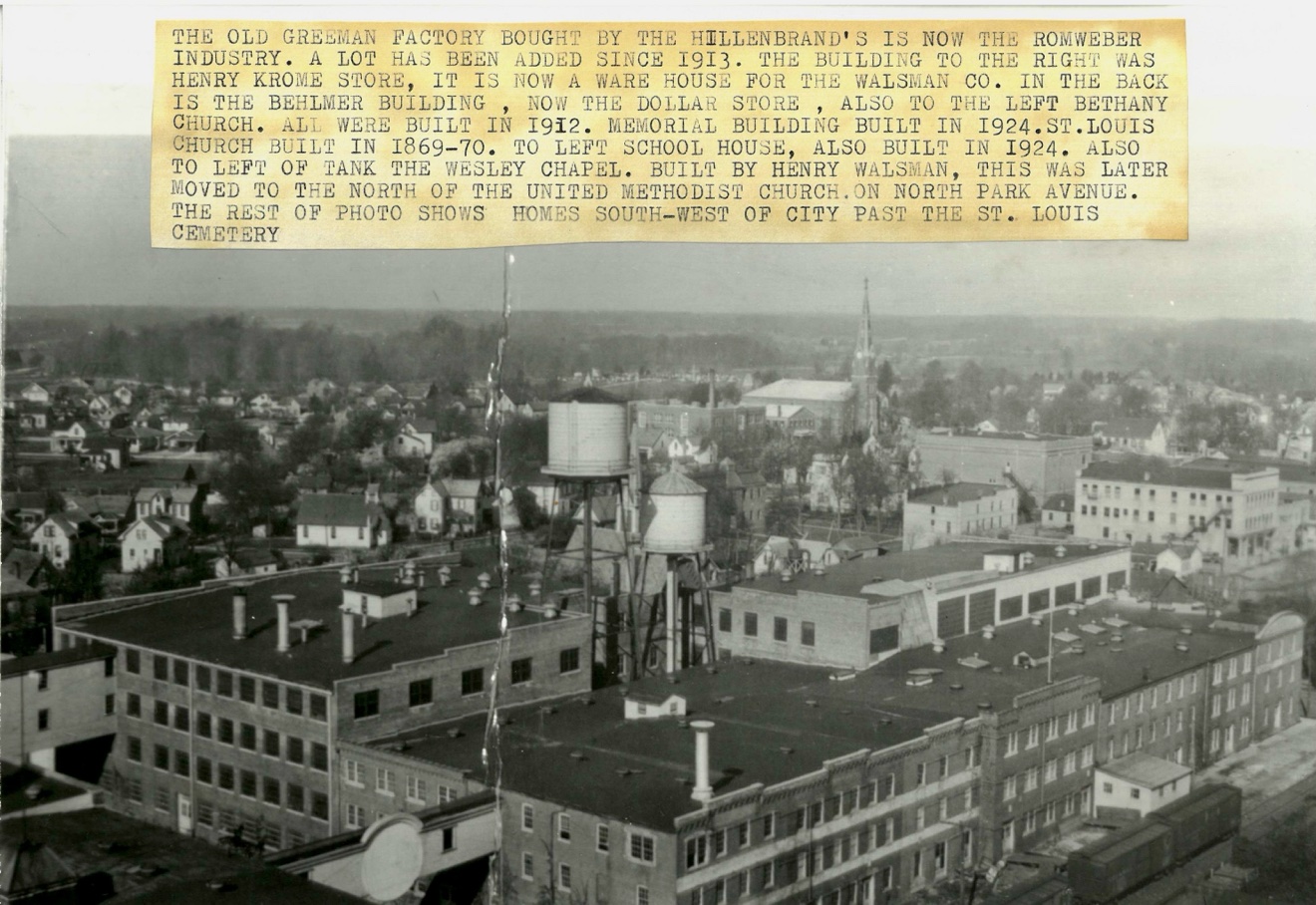
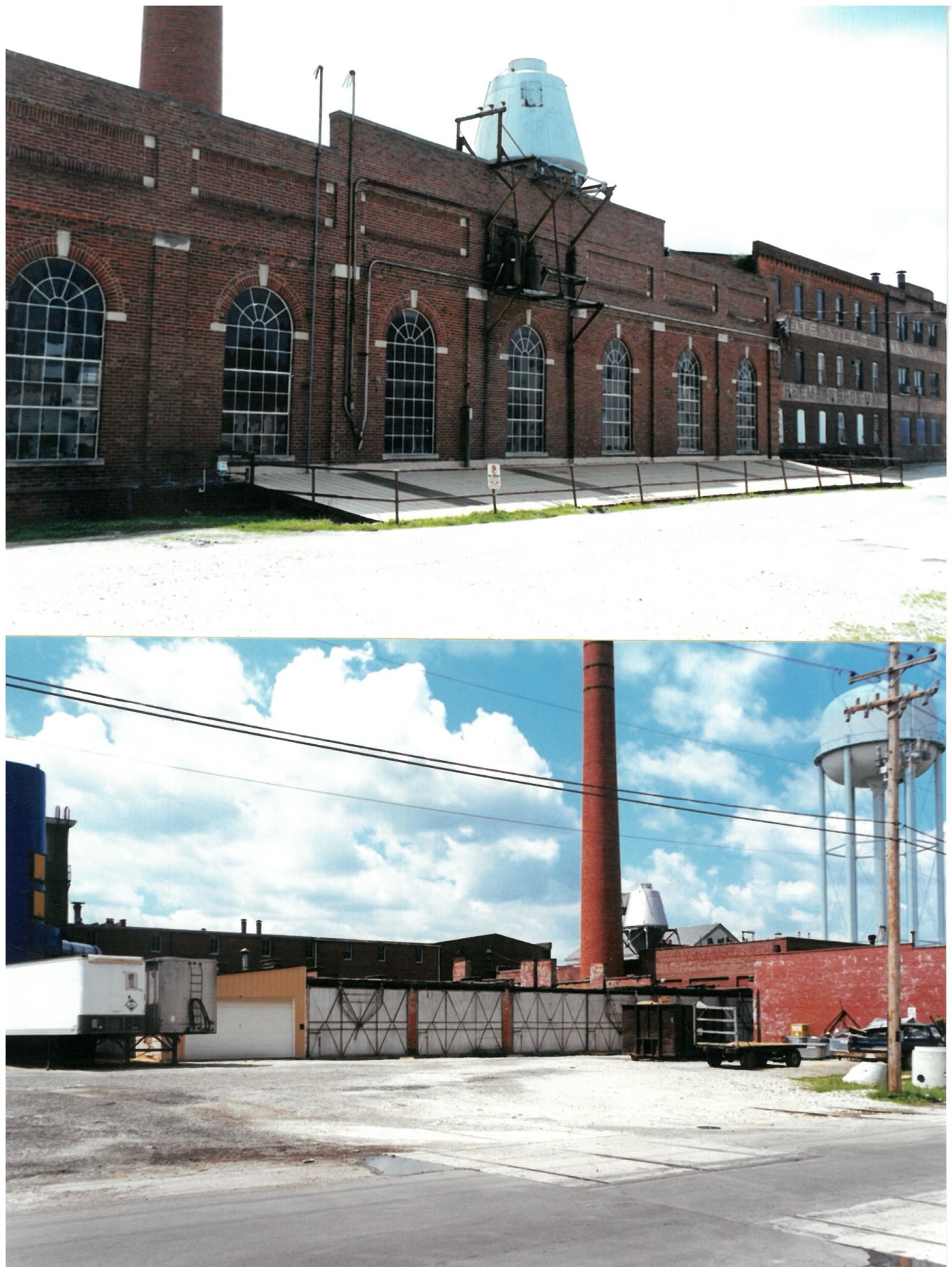
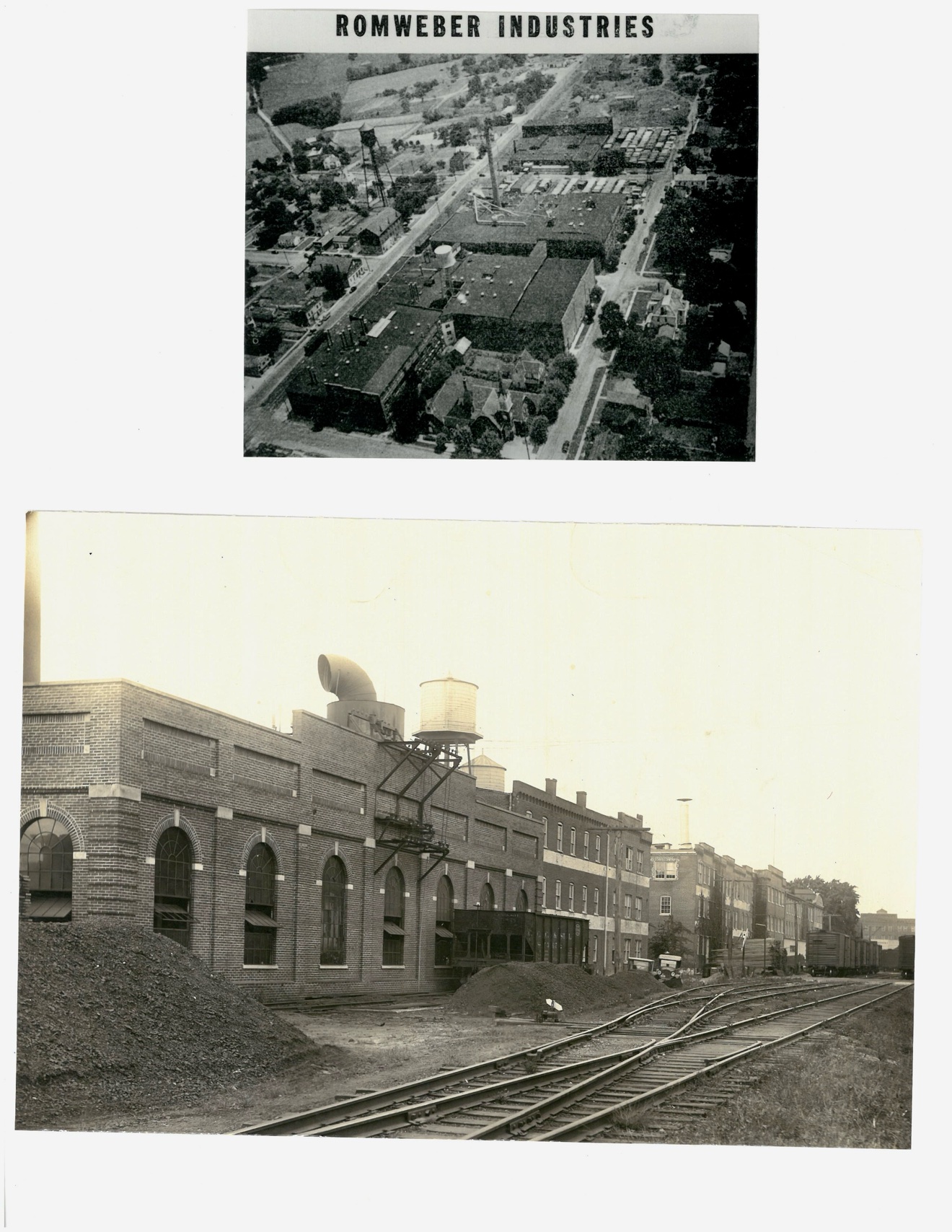
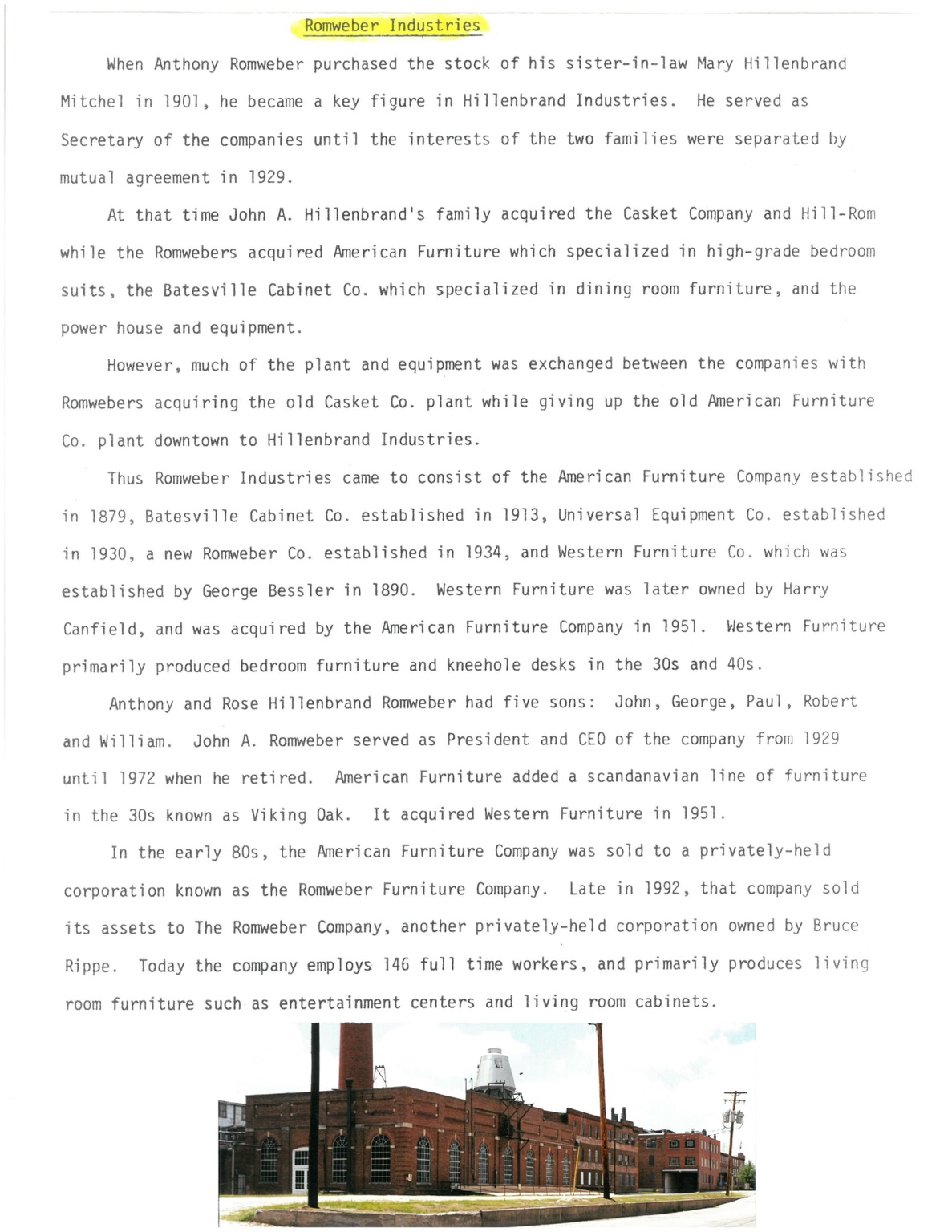
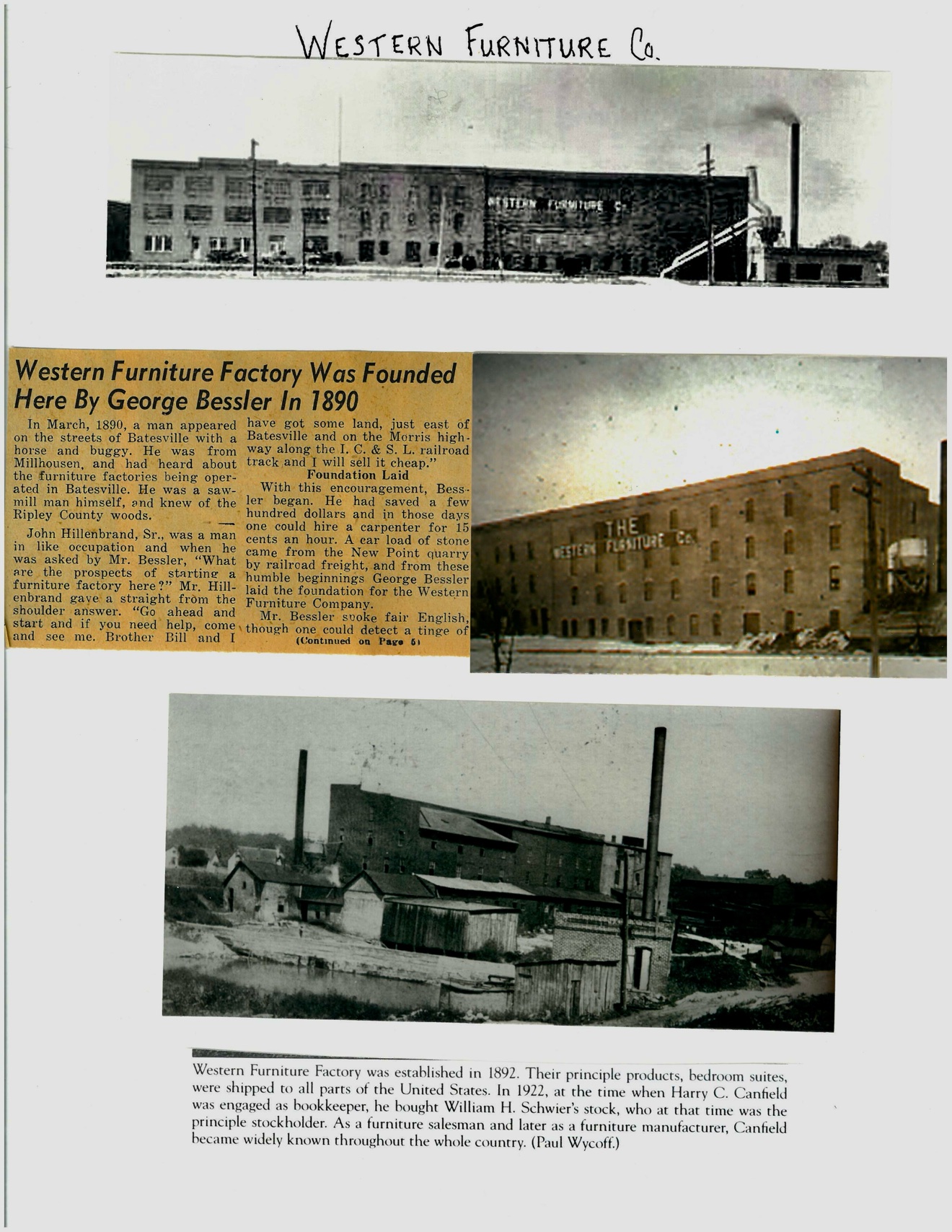
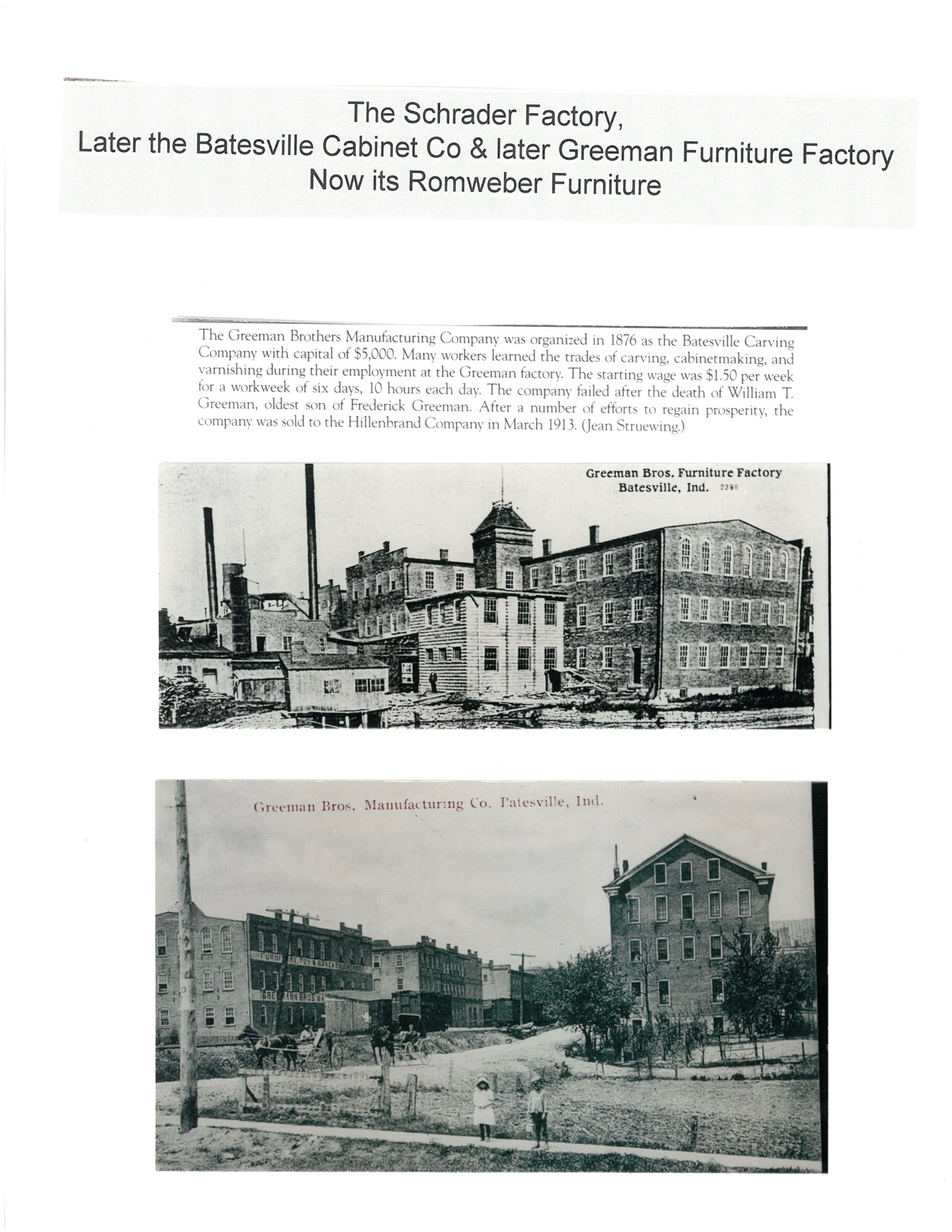
The families split the work in 1929. The hospital-furniture venture got its name from Bill Hillenbrand and his cousin George Romweber's boyhood rabbit-raising enterprise — 'Hil-Rom,' from the first syllables of both last names. The Hillenbrands took the Casket Company and the new Hill-Rom hospital-bed business; the Romwebers took American Furniture, the Batesville Cabinet Company, and the power house — and the two sides swapped plants to do it. Romweber Industries came to be five companies: American Furniture (1879), Batesville Cabinet (1913), Universal Equipment (1930), the new Romweber Co. (1934), and Western Furniture, which George Bessler founded in 1890 after John Hillenbrand Sr. told him, “Go ahead and start.” The roots ran deeper still: Greeman Brothers began in 1876 as the Batesville Carving Company, and the Hillenbrands bought the Greeman factory in 1913. In 1992 the Romweber Company sold to Bruce Rippe’s company.
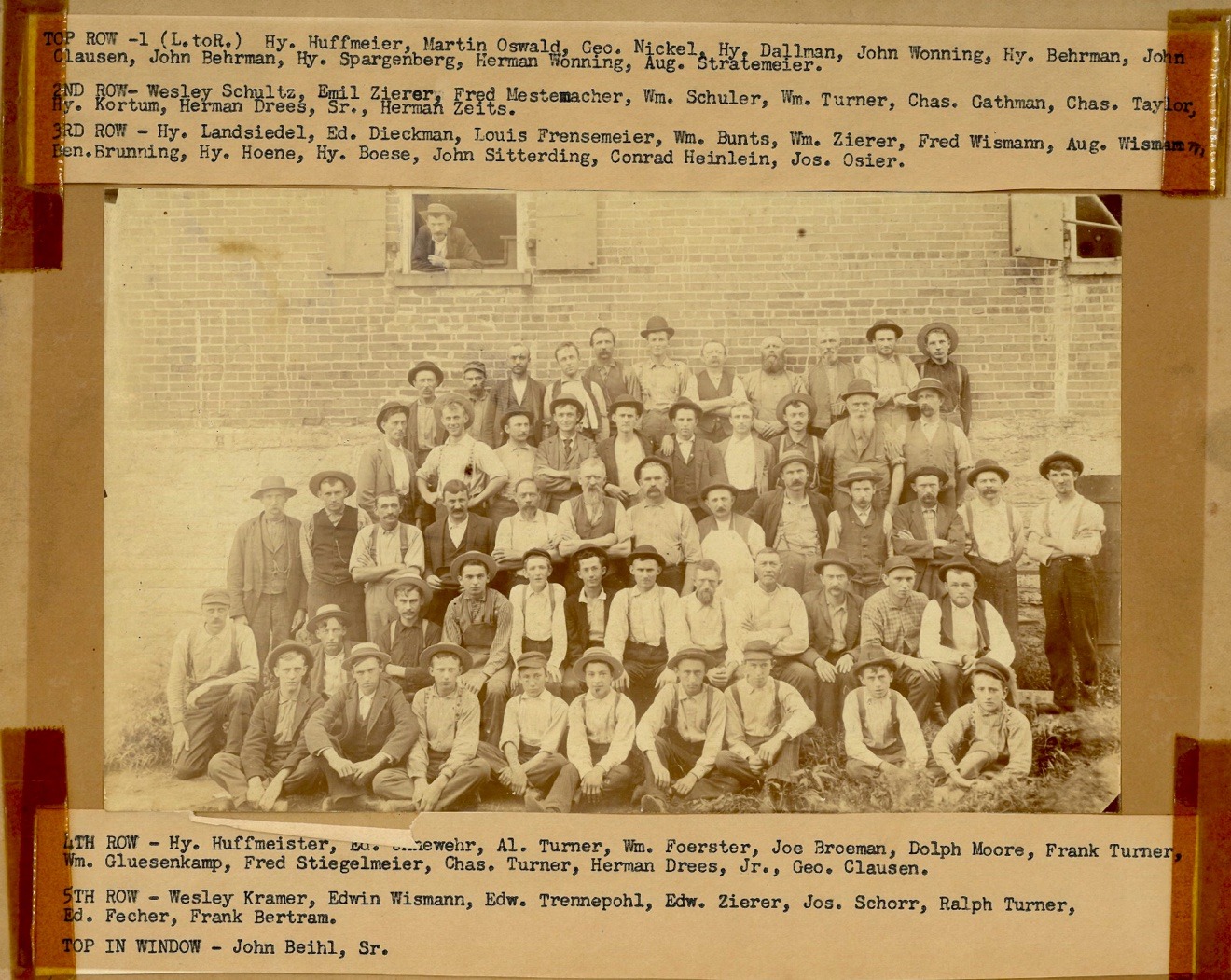
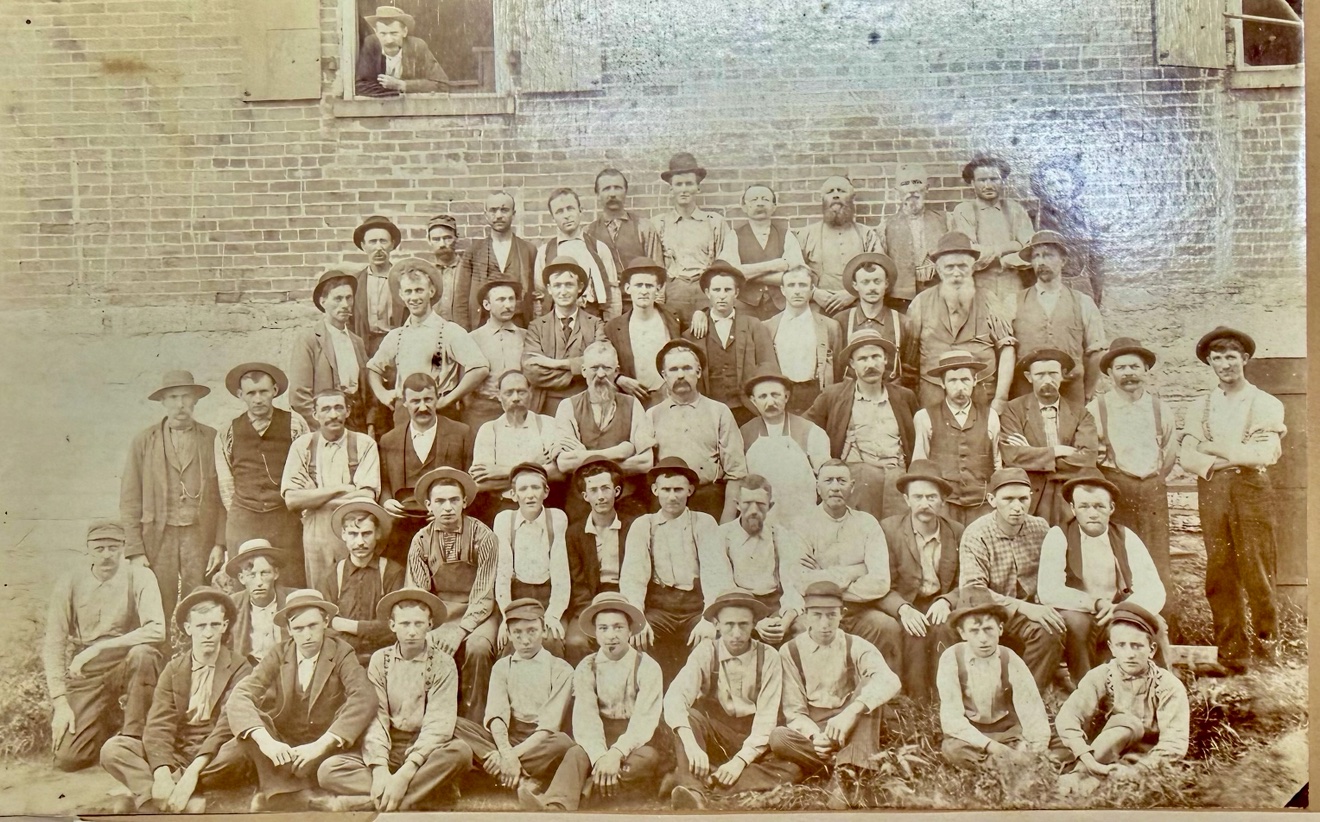
And the men themselves: a group photograph names more than fifty of them, row by row — with John Beihl Sr. looking out the window above them.
Fourteen men served Union Furniture for 50 or more consecutive years; their names hang on a plaque in the company offices: John Hackman, August Wismann, John Wonning, George Beck, Edward Dieckmann, William Foerster, Albert Hackman, John Clausen, Henry Boese, Herman Wonning, Henry Dallman, Henry Hoene Jr., John Schorr, and Louis Thielking. Two more names were added while they were still living: Ervin Green and Ernest Kirschbaum. George Beck — hired as bookkeeper in 1883, president from 1889 to 1934 — was succeeded by Harvey H. Wonning; William Foerster was superintendent from 1905 to 1950.
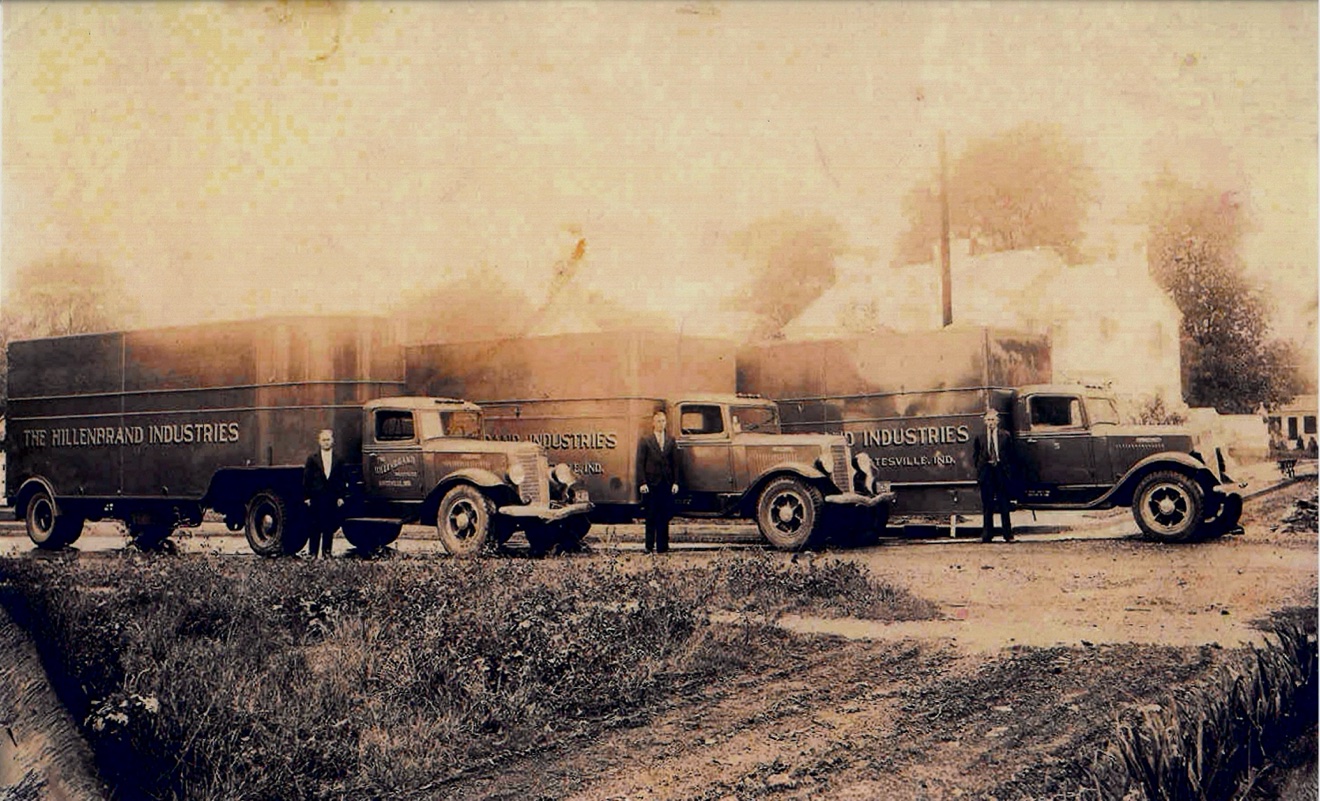
By the mid-1970s the Hillenbrand companies employed almost 3,000 people, with sales over $100 million, shipping by their own truck fleets through 43 Customer Service Centers.
Timeline
How it changed hands.
Seven men form a partnership and put up a 40-by-80 frame factory between Vine and George streets, investing $7,000.
Union adopts its first constitution; capital $30,000, for the manufacture of furniture only.
Fire destroys the frame factory on November 7 — a $25,000 loss, with no insurance. The company incorporates the same year.
Greeman Brothers Manufacturing is organized as the Batesville Carving Company, with $5,000 capital. The starting wage is $1.50 a week for six ten-hour days.
John Hillenbrand founds Hillenbrand Industries.
The American Furniture Company holds its first official meeting on April 21, 1879. First corporate papers are recorded at the County Seat in Versailles on April 30, 1879. Qualifying stockholders: Nicholas Zimmer, Frank Mehlon, and John Yest.
The Batesville Coffin Company is in business, making hand-crafted wooden coffins with ornate engravings.
Fire sweeps the Union plant again on November 9. Work resumes in the new stone-and-brick building in June 1886.
John Hillenbrand Sr. learns of an electric-light generator on a trip to Cincinnati and has a direct-current generator installed for the factory lights; it is soon replaced by an alternating-current generator driving factory machinery.
George Bessler founds Western Furniture. (The caption on the factory’s own page dates it to 1892.)
John Hillenbrand and E.C. Timmerman propose electric street lights to the town board; voters defeat it 161 to 76. A contract follows in 1895, and the lights become permanent fixtures in 1898 — Batesville's electric street lights a 'first' west of Cincinnati.
Anthony Romweber buys his sister-in-law Mary Hillenbrand Mitchel’s stock and becomes a key figure in Hillenbrand Industries.
The American Furniture Company is reincorporated; its affairs are now controlled jointly by the Romweber, Hillenbrand, and Mitchell families.
John A. Hillenbrand rescues the small coffin company from insolvency and renames it the Batesville Casket Company. John A. is commissioned by his father to study the casket market; the company starts making caskets with parallel sides instead of the old 'toe pincher' coffins. A cloth-covered casket sold for six dollars.
John Hillenbrand Sr. dies; his funeral is the largest ever held in the county to that time. His son John A. takes control of the company.
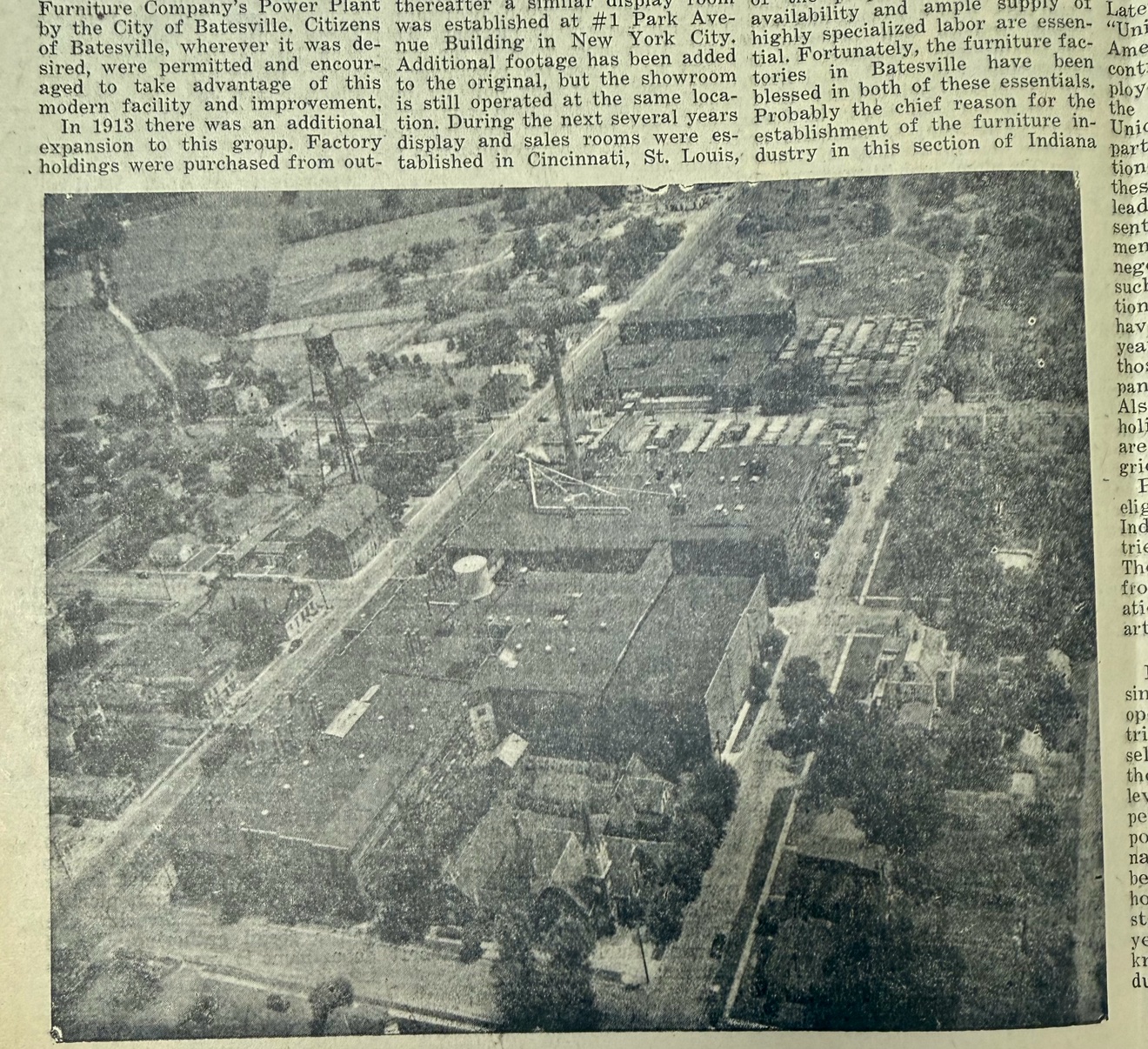
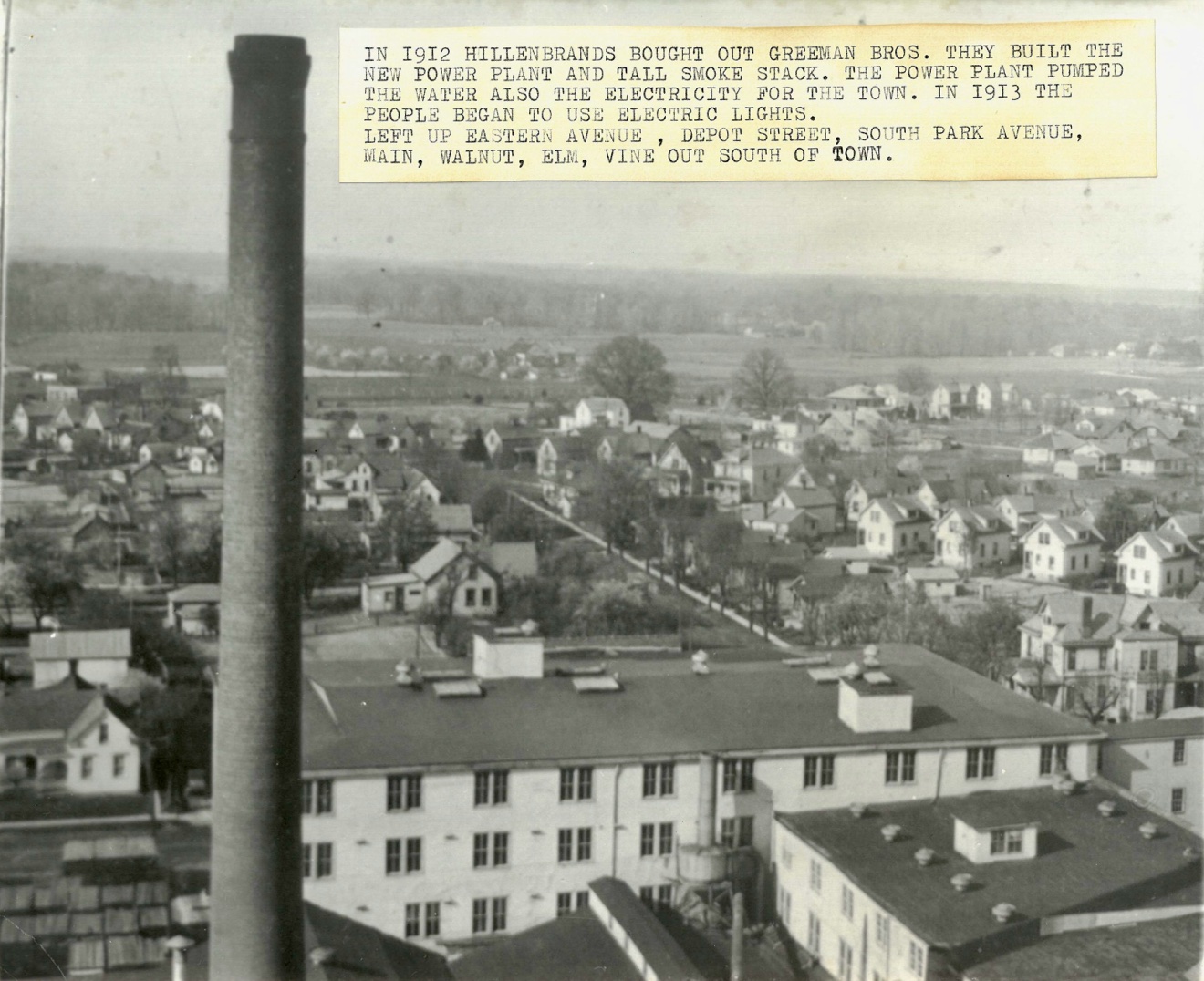
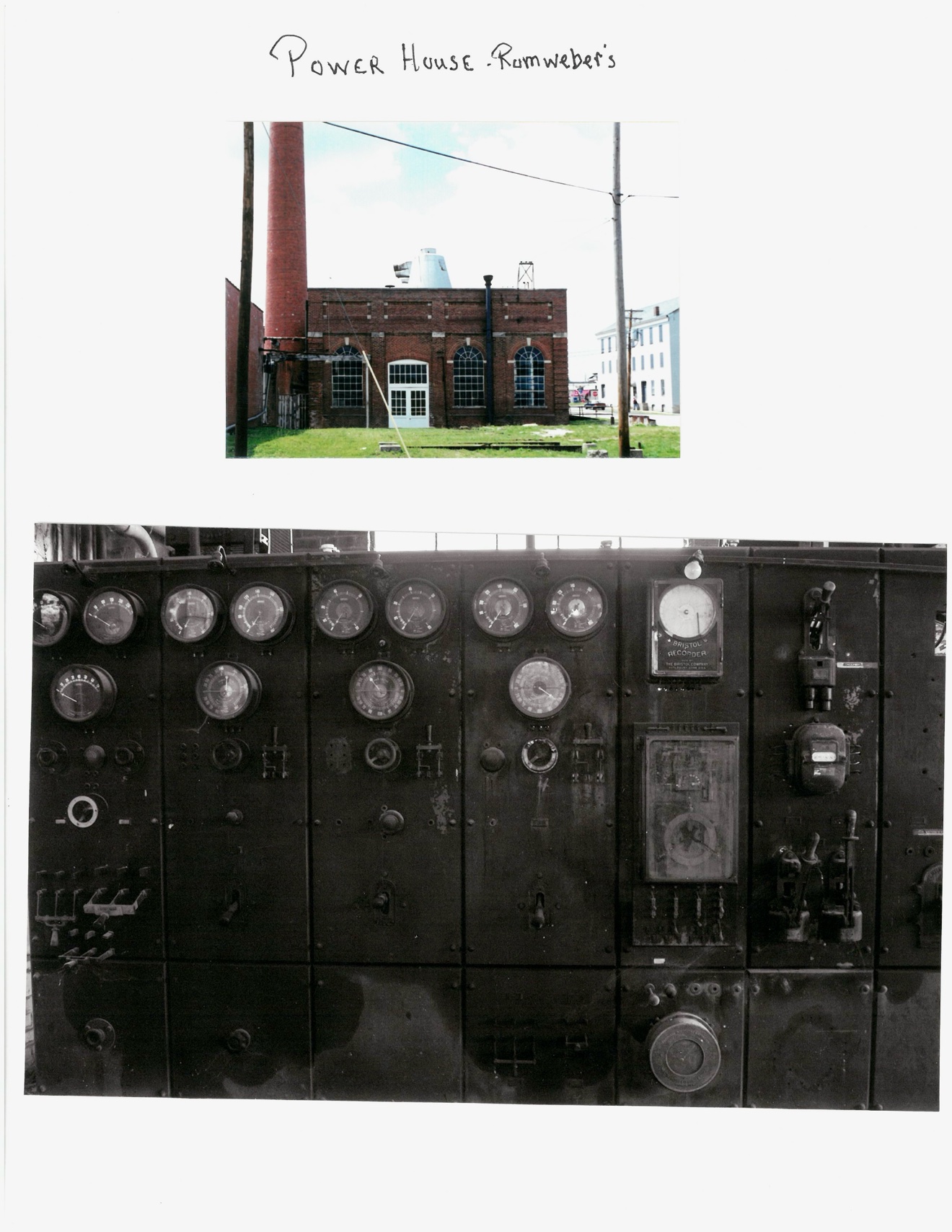
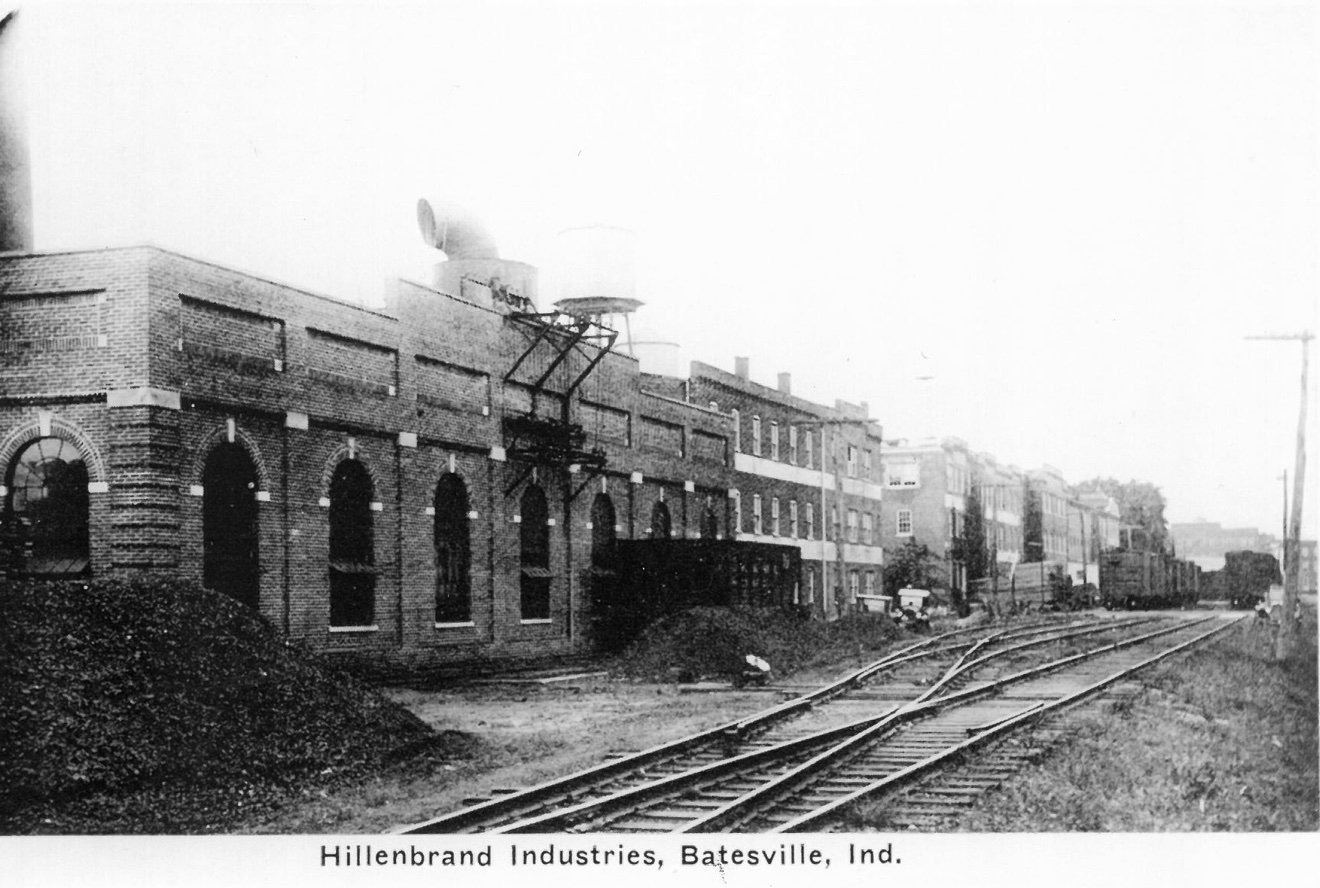
The Hillenbrands buy out Greeman Bros. and build the new power plant and the tall smokestack. The plant pumps the town’s water and generates its electricity. American Furniture inaugurates a sewerage disposal system for the factories and offers it to citizens; reservoirs follow, and citizens tap on — 'the birth of the now present city owned Water Works and Sewerage Disposal Plant.'
Greeman is sold to the Hillenbrand Company in March; the Batesville Cabinet Co. is established; Batesville homes begin using electric lights. The Greeman business is incorporated as the Batesville Cabinet Company, specializing in dining-room furniture on George Hillenbrand's recommendation.
Batesville enters the era of metal caskets, retooling and dropping most wood production. The Casket Company begins making its own casket shells — the first non-wood manufacturing in Batesville — as the Spanish influenza epidemic creates government demand for every casket the company can produce.
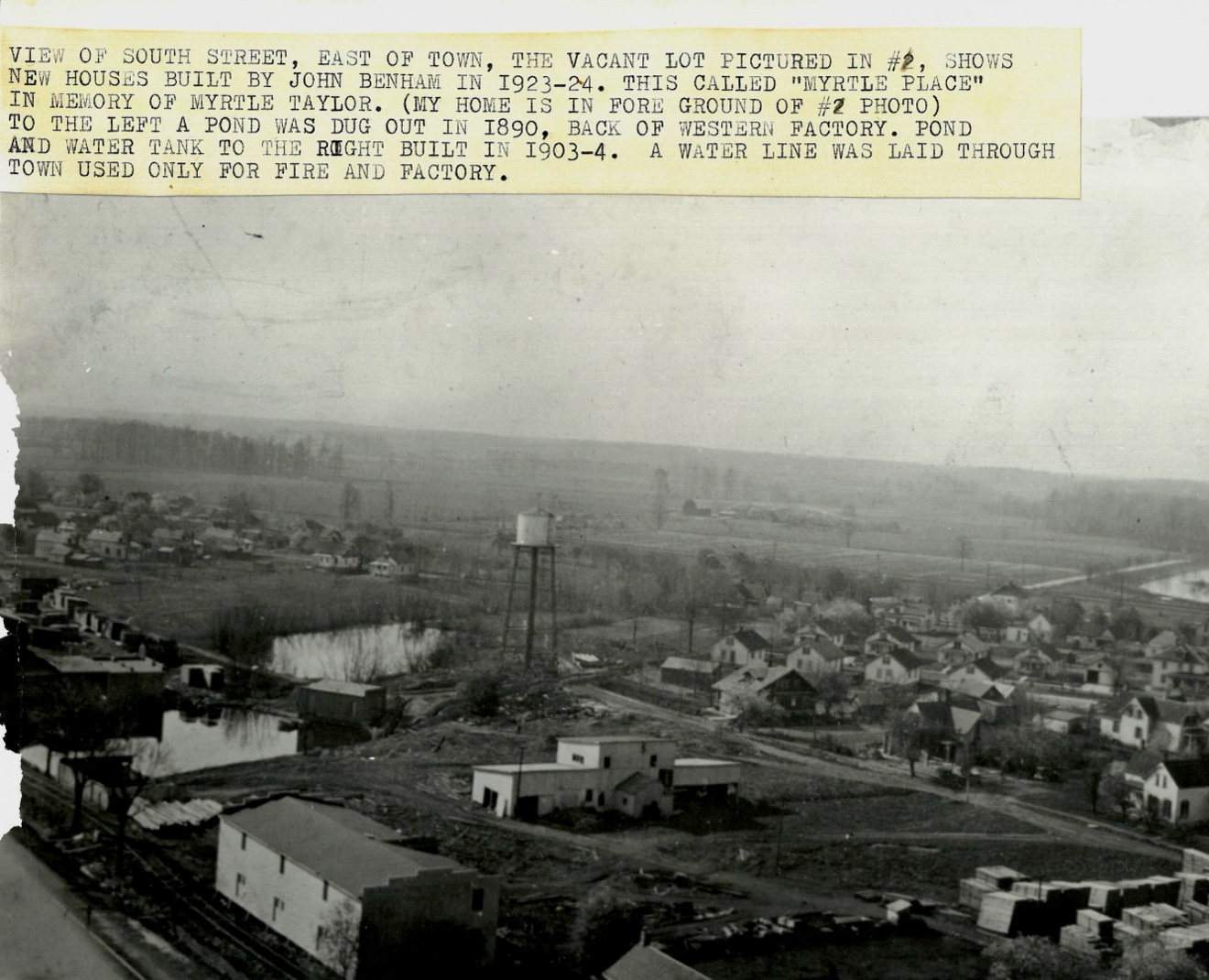
John Benham builds the Myrtle Place houses on South Street, east of town, in memory of Myrtle Taylor.
The two families separate by mutual agreement: the Hillenbrands take the Casket Company and Hill-Rom; the Romwebers take American Furniture, Batesville Cabinet, and the power house. Much of the plant and equipment is exchanged between the companies.
The plant changeover follows the 1929 split: the Romwebers take the old Casket Co. plant, giving up the old American Furniture plant downtown to Hillenbrand Industries.
The companies move their display from Grand Rapids to the Merchandise Mart in Chicago and open a showroom at #1 Park Avenue in New York.
The new Romweber Co. is established. Until 1934 the product is confined to Bedroom and Dining Room furniture; the Romweber Company is added with Peasant-type Oak furniture adapted from Scandinavian designs, plus Modern and Contemporary lines.
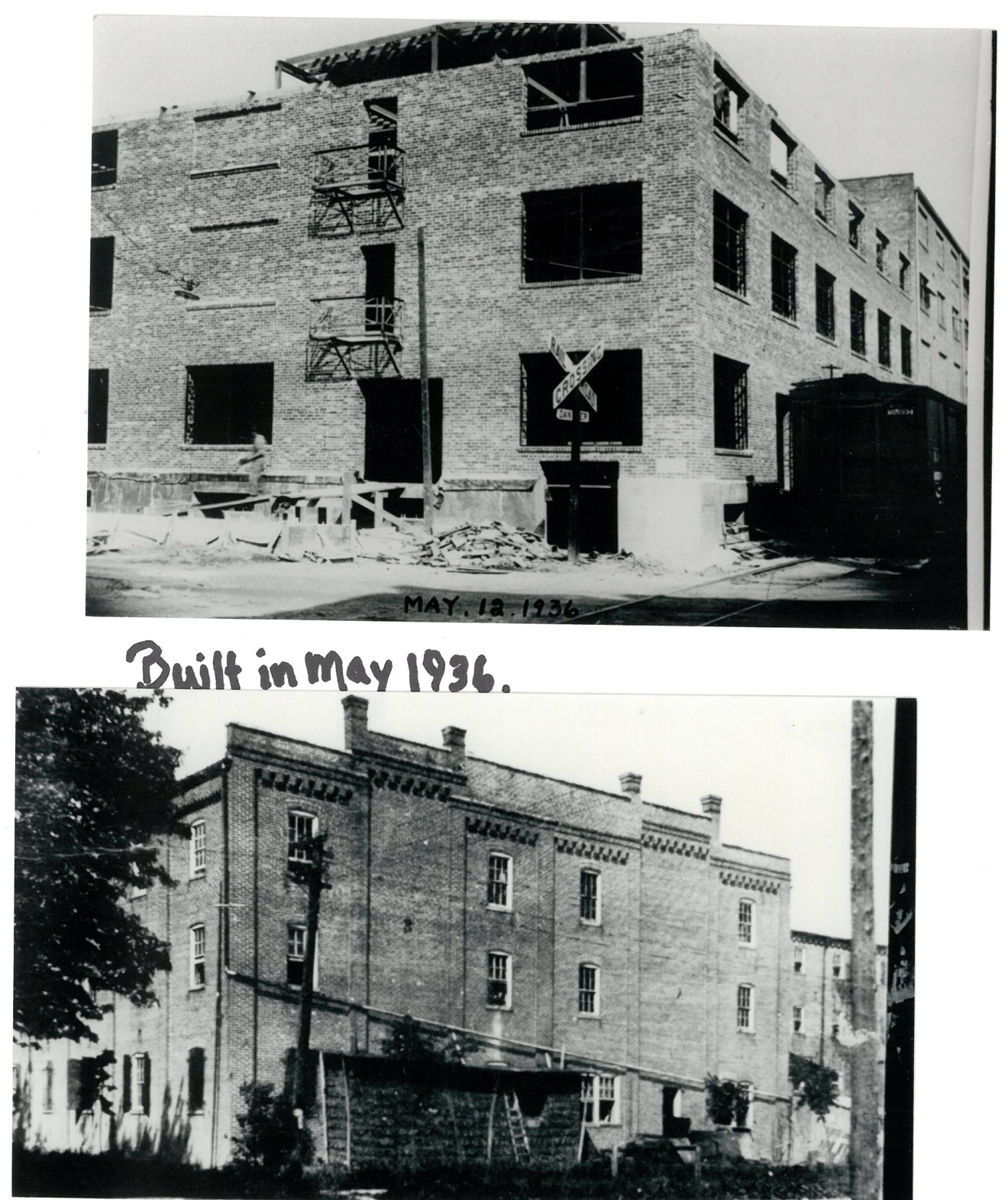
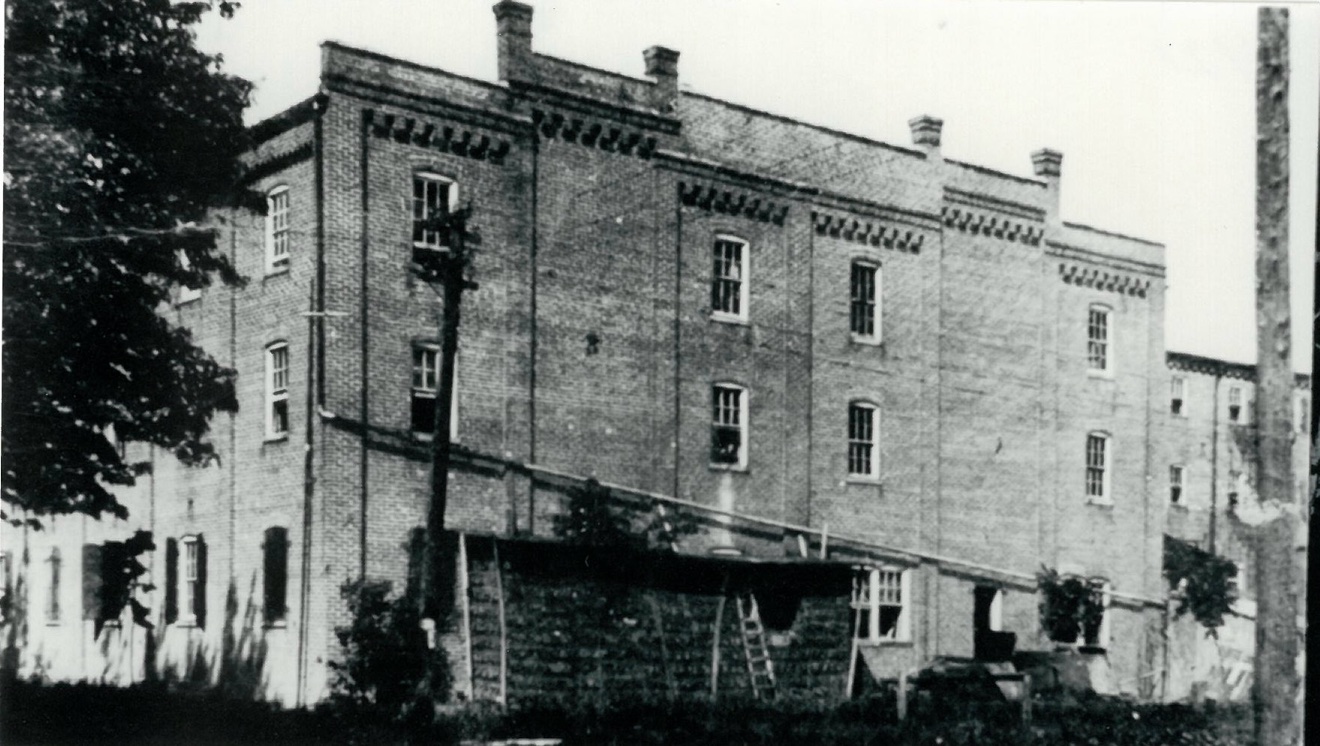
Union Furniture’s new building goes up on West George Street — photographed under construction on May 12, 1936.
The employees have been represented by unions since 1938 — first the Carpenters' and Joiners' Union, then an independent United Employees union, then the United Furniture Workers (C.I.O.), and since 1946 the Upholsterers' International Union.
Eighty-one Romweber Industries employees serve in the Armed Forces; six are killed: George F. Wolters, Delmar F. Shockley, Carl W. Henneke, Adelbert R. Walke, Clifford E. Vierling, and Louis H. Magin. Much of the plant turns to war production, including wood panels for pontoons and airplanes.
Batesville invents the first protective metal casket — the Monoseal — keeping air and water out without a glass inner top.
Hill-Rom markets the first Hilow bed — kept at domestic height, raised to nursing height when procedures need doing.
Hill-Rom produces short safety sides, after Dr. Fred Carter of St. Luke's Hospital in Cleveland argues bedfalls can be prevented with a short side patients hold onto instead of climbing over.
American Furniture acquires Western Furniture. Western had been owned by Harry Canfield; American Furniture acquires its land, plant, machinery, and equipment.
The Electric Hilow bed is introduced.
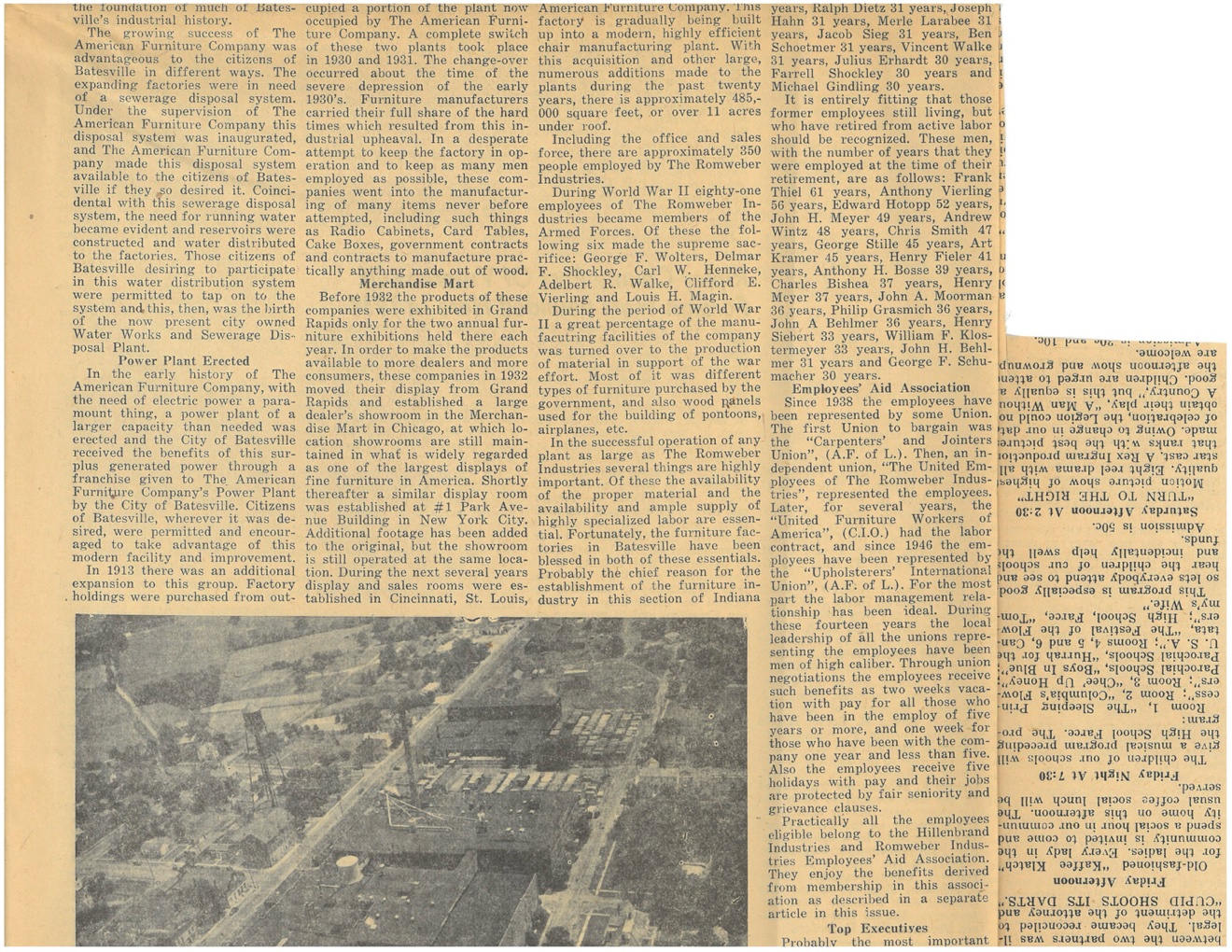
The Herald-Tribune tells the story: American Furniture is the parent of all the present Romweber corporations here.
Union Furniture adopts a new Charter of Incorporation, made perpetual; the old restrictions on stock ownership are removed.
Hill-Rom's All-Electric Bed, Model 68, comes out.
Hill-Rom releases the first intensive care bed and the first Electronic Bedside Cabinet.
Hill-Rom's first Retractable bed.
A strike between the Batesville chapter of the Upholsterers International Union and Hillenbrand Industries runs April to September; Hill-Rom keeps producing and shipping throughout.
Hillenbrand Industries goes public, selling shares to the public — the business had been entirely family owned until 1971 — listed on the American Stock Exchange, then the New York Stock Exchange in 1973.
The Romweber Furniture Company sells its assets to The Romweber Company, owned by Bruce Rippe. The company's own typed history, written after the sale (undated), says it then employed 146 full-time workers, making living-room furniture such as entertainment centers and living-room cabinets.
The Union Furniture building comes down.
Demolition is completed; the elevator shaft, still standing on March 2, is the last piece to come down.
Vine Street and Walnut Street: the Union site, cleared to gravel.
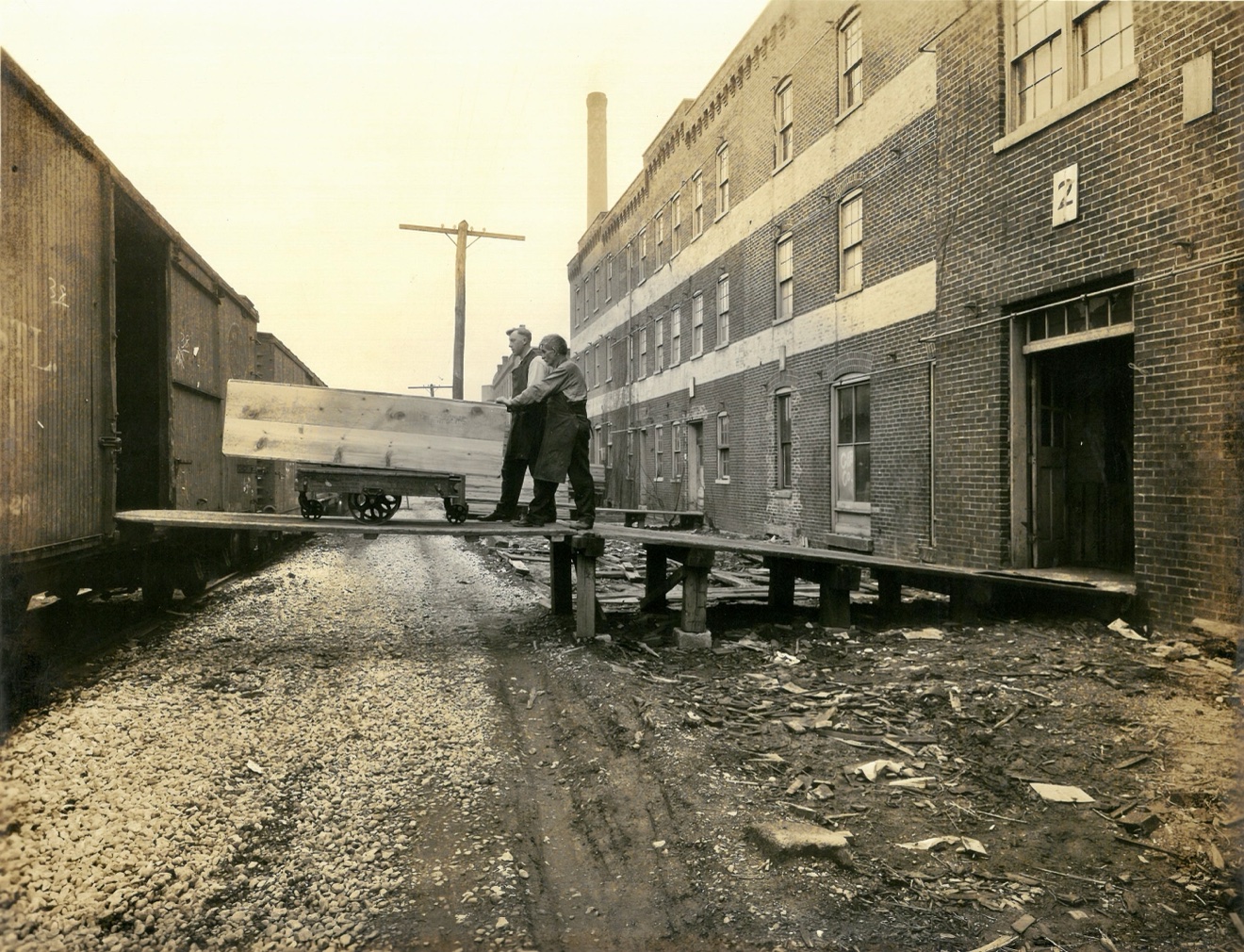
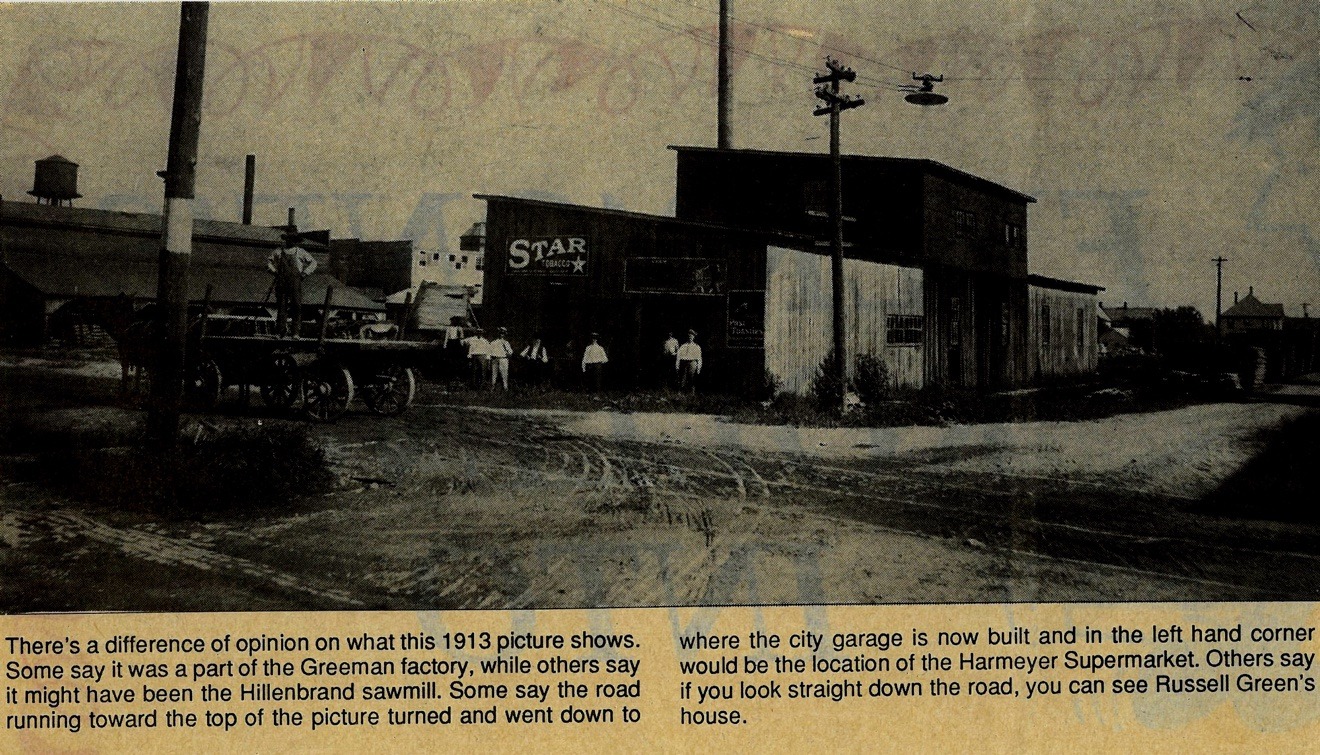
A photograph dated 1913 shows the Star Tobacco building; its printed caption records a disagreement over whether the building was part of the Greeman factory or the Hillenbrand sawmill.
Still to learn
Open questions.
- Who worked at Union Furniture on West George Street, or at the Casket Company on South Street? What do you remember from the factory floor?
- Do you have photos from inside the factories — the floor, the kilns, the lumber yard? They belong here.
- The Star Tobacco photograph's caption records a disagreement — Greeman factory or Hillenbrand sawmill? The caption also argues about the road, the city garage site, the Harmeyer Supermarket corner, and Russell Green's house.
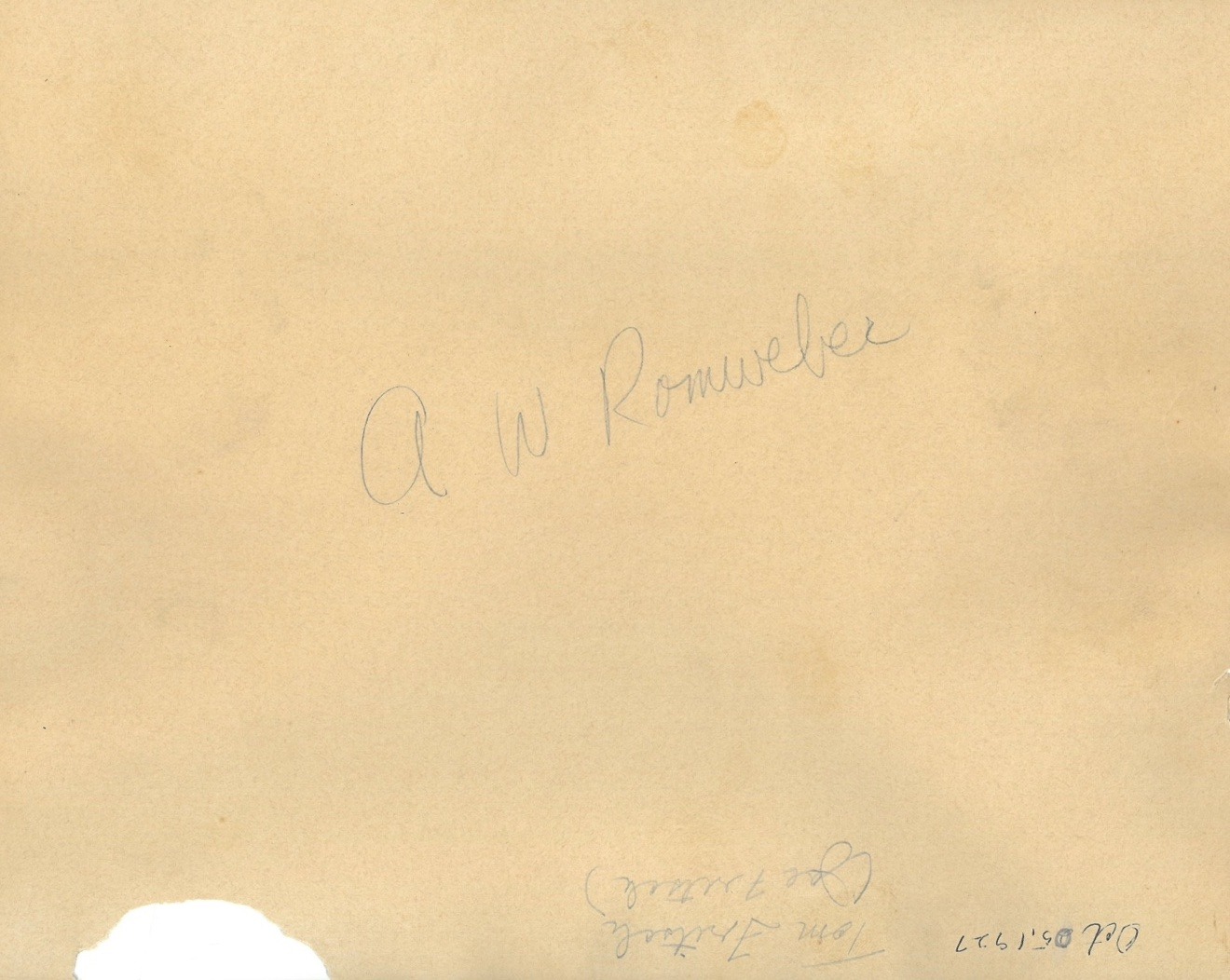
- The workforce mount's back is dated Oct 05, 1927 — is that the photograph's date, or the date the back was annotated? And who were Tom Fritsch (Joe Fritsch) and A. W. Romweber? Neither name is in the typed rows.
- The site's caption calls the workforce the Union Furniture workforce, but no employer name appears on the mount itself — can anyone confirm it?
- Top row 'Hy. Huffmeier' vs fourth row 'Hy. Huffmeister' — one name spelled two ways, or two men?
See also
Connected pieces.
Do you remember this place?
Share a memory, a photo, or a correction — or answer one of the open questions above. Submissions are reviewed by a person before anything appears publicly, and nothing is posted as-is. Photos are used only with your permission and with credit as you give it.
Last updated November 13, 2026. New memories appear here after review.